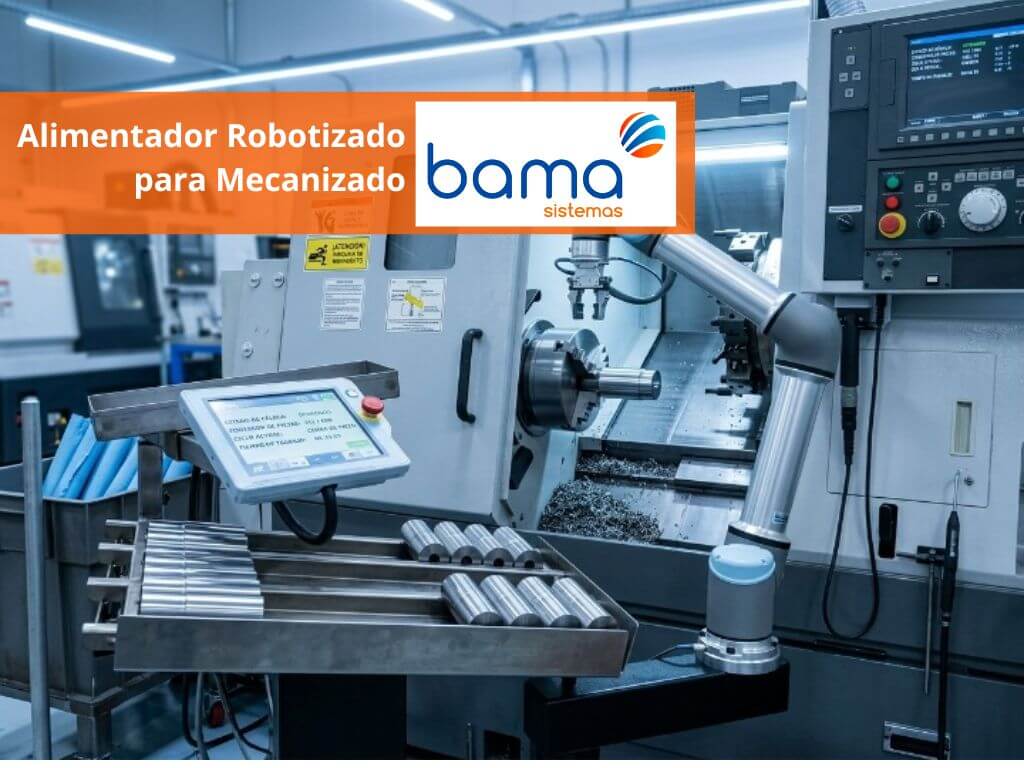
If your workshop still relies on an operator to load and unload parts in the lathe or milling machine, every idle shift is money lost. The robotic feeder for machining is the solution that companies in the metal sector have been implementing for years to produce more, with greater precision, and without stopping the machine between shifts.
Choosing wisely and understanding how it works makes the difference between a profitable integration in 12 months and a system that never delivers on its promises.
What is a Robotic Feeder for Machining?
A robotic feeder for machining is a system that automates the loading and unloading of parts in CNC machines (lathes, milling machines, machining centers) using a programmed robotic arm. Its function is to eliminate manual handling, reduce spindle downtime, and ensure sub-millimeter repeatability in each cycle.
Industrial robot vs. cobot: which fits your cell?
The choice of robot type is the first critical point of any automation project:
| Feature | Industrial Robot | Yes |
| Safety | Mandatory perimeter fencing (ISO 10218-2) | Shared space without barriers (ISO/TS 15066) |
| Repeatability | ±0.002 mm | ±0.02 mm to ±0.05 mm |
| Installation | Weeks | Hours or a few days |
| Ideal for | Mass and static production | Short runs and frequent reconfiguration |
Cobots allow the operator to work alongside the machine without physical fencing, thanks to the Power and Force Limiting (PFL) system, which stops movement in milliseconds upon any unforeseen contact.
The Handshake Protocol: how the robot and CNC communicate
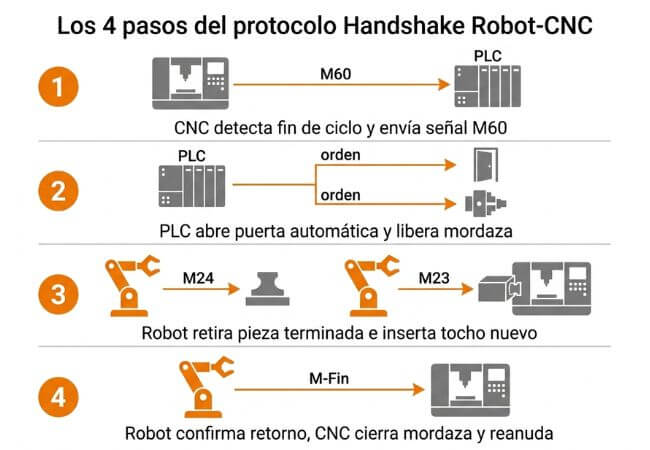
The heart of any robotic machining cell is the synchronization between the arm and the machine. This communication (called the Handshake protocol) is orchestrated by the PLC through digital signals or protocols such as Modbus TCP, EtherNet/IP, or OPC-UA.
The 4 steps of the Robot-CNC handshake
- Cycle complete signal (M60): The CNC finishes cutting, stops the spindle, and positions the tool in a safe zone.
- Access opening: The PLC opens the automatic door and releases the hydraulic clamp. Without this confirmation, the robot cannot enter.
- Robot action (M23/M24): The arm enters, removes the finished part (M24), and inserts the new blank (M23). With double-jaw grippers, everything happens in a single trip: exchange time drops from 30 to 14 seconds.
- M-Fin signal: The robot confirms it has returned to its home position. Only then does the CNC close the clamp and resume the program.
This signal logic prevents collisions, protects the arm’s servomotors, and ensures that each part is seated with tolerances of up to ±0.02 mm.
The EOAT: where precision turns into chips
The EOAT (End-of-Arm Tooling) is the gripper that touches the part. Its selection directly determines the quality of machining:
- Mechanical grippers: High gripping force for heavy or irregular parts.
- Magnetic grippers: Ideal for ferrous materials; reduce the overall weight.
- Vacuum grippers: Perfect for flat surfaces, although they require air blowing before each pickup to prevent chip obstruction.
A positioning error of just 0.05 mm during loading can lead to out-of-tolerance parts throughout the entire series. Choosing the right EOAT is not a detail: it is the foundation of quality.
Advantages of a CNC machine feeder with a robot for your company
Integrating an automatic machining feeder transforms workshop operations in three key dimensions:
- 24/7 Production: Lights-out manufacturing allows for unattended night shifts, multiplying productive spindle hours.
- Safety and regulations: You remove the operator from a hazardous task, complying with ISO 10218 and preventing musculoskeletal disorders from repetitive loading of parts up to 50 kg.
- ROI in 12-18 months: Maximizing spindle time and reducing part rejection allow for investment recovery within 12 to 18 months.
Furthermore, a single CNC machining assembly robot with a seventh axis (linear track) can serve up to 3 machines simultaneously, tripling the robotic unit’s performance.
Implement your automatic CNC feeder with a robot with Bama Sistemas
The starting point is always a technical analysis of your current cell: part type, cycle times, CNC protocol, and the most suitable robot type for your production.
Bama Sistemas supports companies in the metal sector throughout the entire robotic integration process: from cell design to commissioning and team training. Contact their engineering team and discover if your workshop is ready to take the leap.
Your CNC should never stop: start today
The robotic feeder for machining is not future technology; it’s the competitive advantage your competitors are already evaluating. Every manual loading cycle that remains in the hands of an operator is a cost that silently accumulates. Automating is not about replacing people: it’s about freeing their talent to supervise, optimize, and lead production. That is the true leap of Industry 4.0.
Do you want to automate your CNC feeding?
Request a technical evaluation with BAMA and discover the best robotic solution for your production.