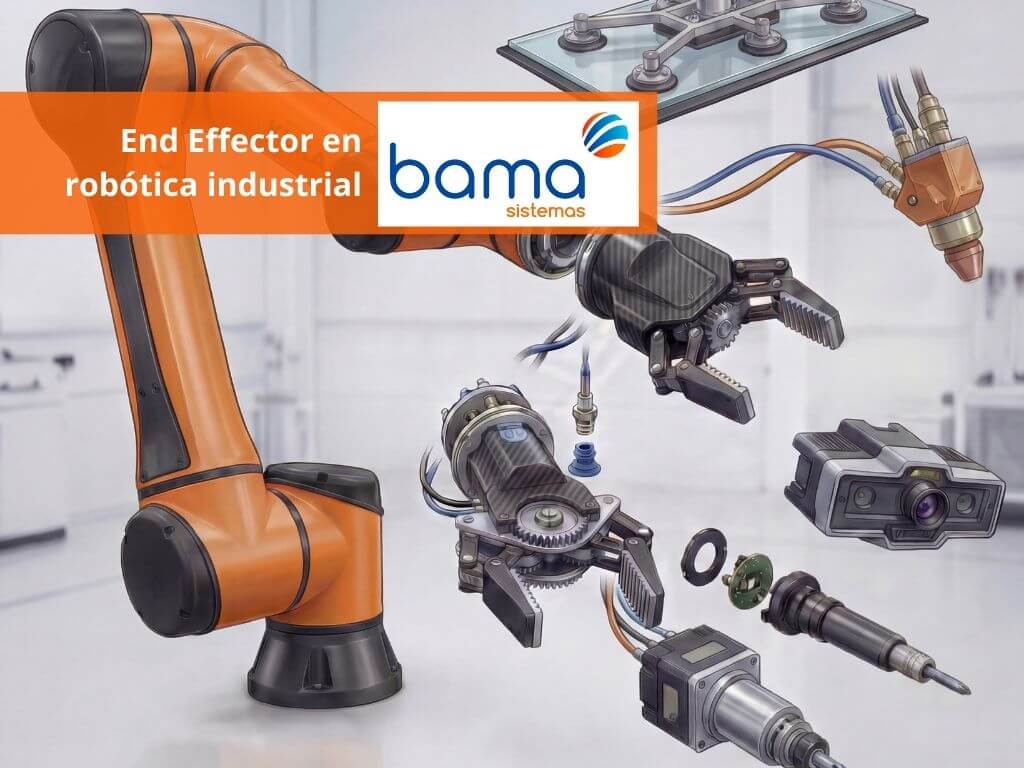
If you are looking to optimize industrial processes through advanced robotic solutions, understanding what an End Effector is represents a fundamental step. At BAMA Sistemas, a company specializing in automation and industrial robotics, we help companies like yours select, adapt, or change end effectors according to their specific needs. Continue reading to discover everything you need to know about this key tool in robotics.
What is an End Effector in Industrial Robotics?
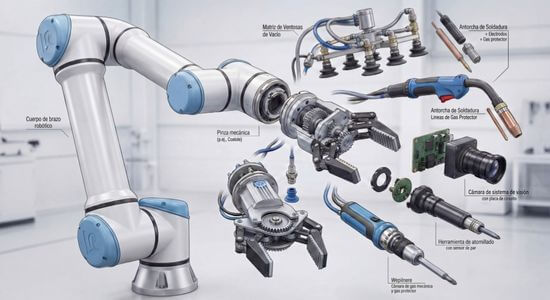
The end effector, also known as the robot’s end effector, is the device attached to the end of the robotic arm whose primary function is to interact directly with objects or materials. It acts as the robot’s “hand,” executing tasks such as gripping, welding, inspection, or handling.
Difference Between End Effector, EOAT, and Robotic Grippers
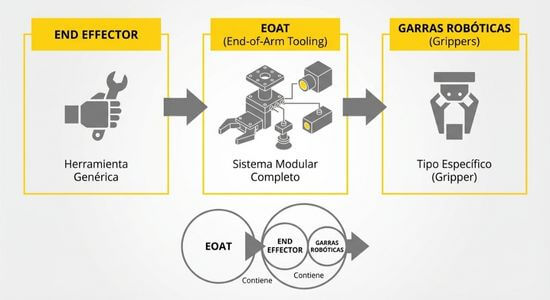
It is common for those new to industrial automation to confuse these terms or use them interchangeably. However, each has a precise definition and a different technical scope:
- End Effector: This is a generic term referring to any tool or device mounted at the end of the robotic arm. It is the component that executes the final action, such as gripping, welding, or measuring. It may be a gripper, a suction cup, a welder, or even a camera.
- EOAT (End-of-Arm Tooling): This is a broader category that includes not only the end effector itself, but also all the accessories and mechanisms necessary for its operation, such as sensors, quick-change systems, adapters, and control components. It is a modular and adaptable system, key to achieving versatility in production.
- Robotic Grippers: These are a specific type of end effector, designed exclusively to hold or manipulate objects. They can be classified as electric, pneumatic, hydraulic, or magnetic grippers, and are selected according to the type of part, weight, and level of precision required.
Understanding these differences is essential to correctly define the technical requirements of a robotic cell and ensure that the system is efficient, precise, and scalable.
Types of End Effectors in Industrial Robotics
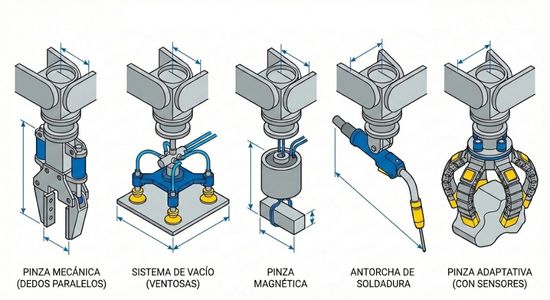
Selecting the appropriate type of end effector is one of the most critical aspects of any automation project. Not all robots perform the same tasks, which is why different gripping and handling solutions exist, adapted to the specific requirements of each industry and application. From simple clamping systems to advanced process tools, end effectors offer a wide variety of technologies to optimize precision, efficiency, and safety.
Robotic Grippers
These effectors use mechanical fingers to hold objects. They can be pneumatic grippers for robots, hydraulic, or electric grippers, and range from parallel to angular models, with force-sensing and precise positioning capabilities.
Vacuum Gripping Systems
They use suction cups to adhere to smooth surfaces through suction. Common in palletizing, packaging, and fragile material handling applications, these systems are highly efficient, though sensitive to dust and irregular surfaces.
Magnetic Grippers
Designed to handle ferrous materials, these grippers employ permanent magnets or electromagnets, making them ideal for grippers for sheet metal handling in heavy industrial environments such as automotive or metallurgy.
Process End Effectors
They integrate active tools such as welders, cutters, dispensers, or 3D printers. They are used when the robot must perform a direct action on the part, such as spot welding or laser cutting.
Intelligent and Adaptive End Effectors
Equipped with sensors and vision technology, they enable advanced control over handling. Some models include artificial intelligence algorithms to auto-adjust gripping or perform real-time inspections.
Applications of the End Effector in Industry
Each industrial sector has unique needs regarding handling, precision, and operating speed. End effectors, in their multiple configurations, allow robots to be adapted to these specific demands, facilitating tasks from the assembly of electronic components to the palletizing of heavy loads. The most common applications according to the production environment are detailed below.
Automotive Industry
Effectors enable operations such as welding, windshield placement, painting, and metal part handling. The use of grippers for palletizing or quick-change systems between tools is common.
Food Industry
EOAT for the food industry manufactured with hygienic materials and sealed designs are used. These tools allow fresh food to be handled without damage, thanks to soft grippers or adaptive suction cups.
Logistics and Palletizing
End effectors for palletizing are designed to load boxes, drums, or bags. Hooks, grippers, and large suction cups adapt to the type of merchandise, improving efficiency and reducing human effort.
Electronics Industry
It requires high-precision effectors capable of handling microcomponents. Robotic grippers for delicate handling such as circuit boards, sensors, or chips are employed.
Metal Industry (Precision Boilermaking)
Reinforced effectors are used for heavy loads and welding, cutting, or loading/unloading operations on CNC machines. They are also applied in sealing and adhesive application tasks.
How to Choose an End Effector for an Industrial Application
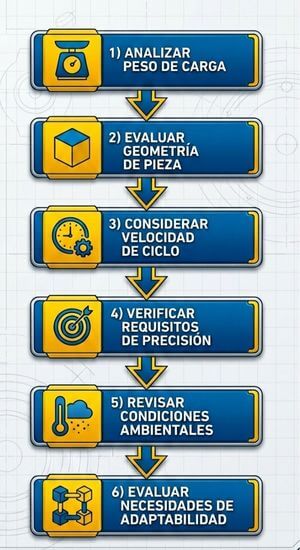
Choosing the right effector depends on:
- Load weight
- Part geometry and material
- Work cycle speed
- Required precision level
- Environmental conditions (temperature, dust, humidity)
- Need for adaptability (modularity, quick changes)
A detailed analysis of these factors ensures optimal and safe integration.
Advantages of Using EOAT in Industrial Automation
- Greater productivity in repetitive processes.
- Improved precision and quality in critical tasks.
- Flexibility to change tasks without the need for manual intervention.
- Reduction of occupational risks in hazardous environments.
Trends and Future of End-of-Arm Tooling
The development of new technologies is profoundly transforming the design and capabilities of end effectors. Demands for precision, adaptability, and energy efficiency are driving the integration of advanced materials, intelligent sensors, and artificial intelligence algorithms directly into EOAT. These innovations not only improve operational performance but also enable companies to quickly adapt to changes in production or product type, setting a new standard in industrial automation.
- Soft robotics: flexible grippers for fragile parts.
- Integrated sensors and machine vision.
- Embedded AI for adaptability and predictive maintenance.
- Quick-change systems and modular configurations.
The evolution of EOAT drives intelligent automation, making it more precise and versatile.
Do You Need to Optimize Your Robot with the Right End Effector?
Low-Medium