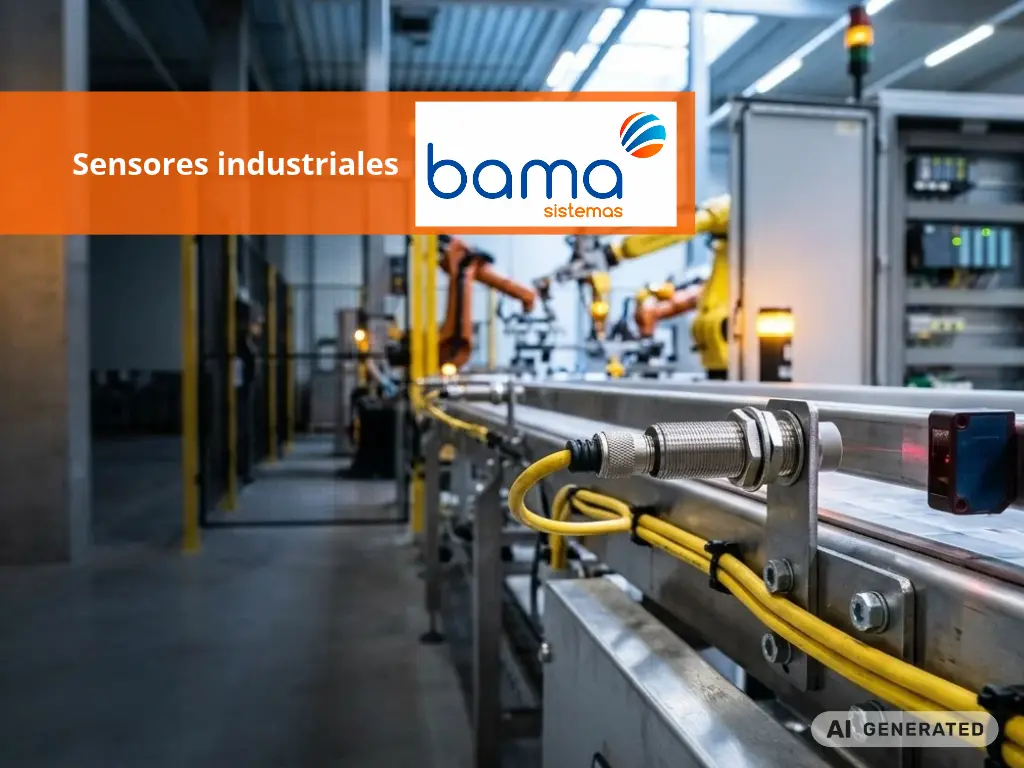
How many decisions does your plant make every minute without anyone stepping in? Starting a conveyor, closing a valve, rejecting a defective part. None of them would be possible without industrial sensors, the devices that translate what happens on each machine into a language the PLC understands.
That is why it pays to choose them carefully, not just from a catalog. In this guide, we review the available technologies, how they connect to the control system, and the checklist that separates a reliable installation from one that causes trouble every week.
What is an industrial sensor and how does it work?
An industrial sensor is a device that detects a physical or chemical variable (presence, temperature, pressure, level, flow, or vibration) and converts it into an electrical signal that a control system can understand. Unlike a consumer sensor, it is designed to operate 24/7 amid dust, vibration, high-pressure water, and electrical interference.<br/>
Sensor, transducer, and transmitter: Not the same thing
These three terms are often used interchangeably, but each plays a different role in the measurement chain:<br/>
| Element | What It Does | Example |
|---|---|---|
| Sensor | Responds to the physical variable | The platinum resistor in a PT100 |
| Transducer | Converts one form of energy into another | The PT100 converts heat into a change in resistance |
| Transmitter | Conditions the signal and outputs a standardized signal | A head-mounted transmitter that converts the PT100 signal to 4–20 mA |
From sensor to PLC: The data path
Every sensor goes through three stages: it captures the variable, conditions the signal (amplifying, filtering noise, and linearizing it), and delivers a standard output. That output reaches the programmable logic controller (PLC), which decides what to do, and from there it moves up to the operator’s HMI or to the SCADA system that supervises the plant. If the input data is bad, every decision made above it will be wrong.
Types of industrial sensors
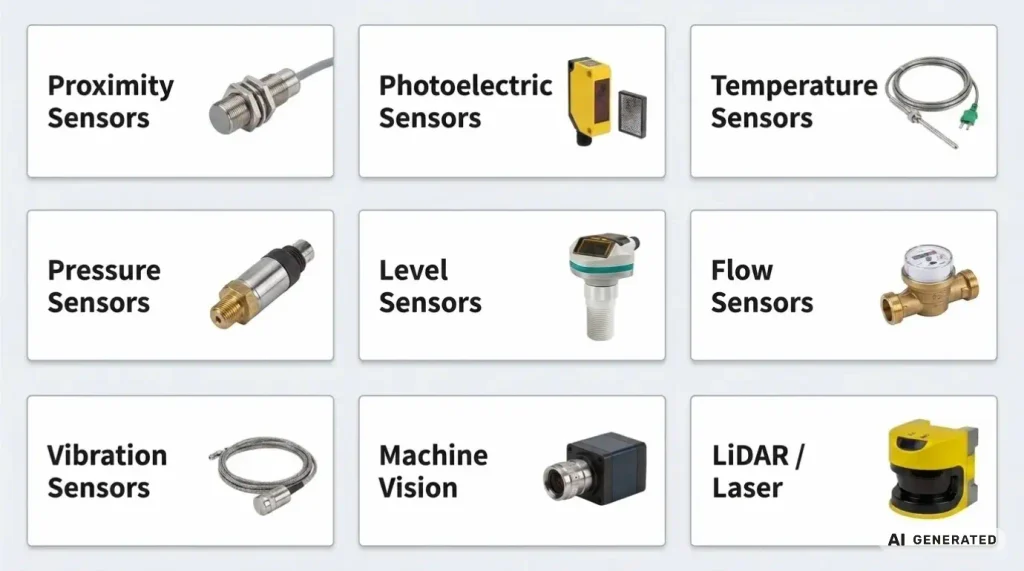
There are hundreds of models, but almost all types of industrial sensors can be grouped by the variable they measure. This table serves as a quick map before we look at each family:
| Family | Main technologies | What It detects or measures |
|---|---|---|
| Proximity | Inductive, capacitive, magnetic | Non-contact object presence |
| Photoelectric | Through-beam, retroreflective, diffuse | Presence and passage at longer distances |
| Temperature | PT100, thermocouple, NTC, infrared | Process and surface temperature |
| Pressure | Gauge, absolute, differential | Fluid and gas pressure |
| Level | Radar, ultrasonic, hydrostatic, float | Level of liquids and bulk solids |
| Flow | Electromagnetic, Coriolis, vortex | Flow of liquids, gases, and steam |
| Vibration | MEMS and piezoelectric accelerometers | Condition of rotating machinery |
| Vision and LiDAR | 2D/3D cameras, laser scanners | Shape, defects, and obstacles |
Proximity and photoelectric sensors
These are the most widely installed sensors on any line because they detect without contact and do not wear out. Inductive sensors only detect metal and are immune to oil and chips, which is why they dominate in machining. Capacitive sensors detect plastic, wood, liquids, or granular materials, even through the wall of a non-metallic tank. Photoelectric sensors use a light beam and reach longer distances: through-beam (emitter and receiver facing each other), retroreflective (with a reflector), or diffuse (the object itself reflects the light).
Temperature sensors
The choice depends on range and accuracy. The PT100 is the benchmark for processes between −200 and 600 °C thanks to its stability. Thermocouples cover much higher temperatures, up to 1,200 °C for Type K, in exchange for slightly lower accuracy. NTC thermistors are inexpensive and fast for narrow ranges, and infrared pyrometers measure moving parts or parts too hot to touch without contact.
Industrial pressure sensors
Industrial pressure sensors monitor hydraulic, pneumatic, steam, and water circuits. They measure gauge pressure (relative to atmospheric), absolute pressure (relative to vacuum), or differential pressure (between two points, useful for knowing when a filter is clogging). A well-selected pressure transmitter detects leaks, pump cavitation, or damaged seals before they cause downtime. For viscous or hygienic fluids, versions with a stainless steel isolating diaphragm are used.
Level and flow sensors
For level measurement, radar is the most reliable option in tanks with foam, vapor, or turbulence; ultrasonic sensors are a cost-effective alternative for clean liquids; and float or vibrating level switches are sufficient for high or low level alarms. For flow measurement, electromagnetic flowmeters cause no pressure drop in conductive liquids, and Coriolis flowmeters measure mass directly, which is key in precision dosing.
Vibration sensors and machine vision
Accelerometers installed on motors, pumps, and compressors detect imbalance and bearing wear weeks before a failure. Machine vision and LiDAR, meanwhile, inspect parts, detect defects invisible to the human eye, and guide autonomous vehicles around the plant.
Output signals: How a sensor communicates with the PLC
Two identical sensors may not work on the same machine if their output does not match the PLC’s I/O card. That is why the signal type is as important a decision as the sensing technology. These are the most common options:<br/>
| Output | What It transmits | When to choose It |
|---|---|---|
| Digital PNP / NPN | On/off (part present or not) | Detection and counting. PNP is the standard in Europe |
| Analog 4–20 mA | Continuous value via current | Long distances and noisy environments; detects broken wires |
| Analog 0–10 V | Continuous value via voltage | Short runs and simple equipment |
| IO-Link | Value, diagnostics, and parameters | Plants pursuing predictive maintenance and fast changeovers |
IO-Link deserves special mention. It uses the same standard three-wire cable, but the sensor also sends alerts on contamination, operating hours, or internal temperature. And if it fails, the IO-Link master automatically loads the configuration into the replacement, so the technician does not have to set parameters manually.
Sensors for industrial automation: Applications and benefits
Sensors for industrial automation are found in any process that repeats and must produce the same result every time. These are the most common applications across industry:
| Sector | Key sensors | Purpose |
|---|---|---|
| Automotive | Inductive, vision, safety scanners | Part positioning, weld inspection, robotic cell protection |
| Food and beverages | Level, flow, IP69K temperature | Filling, dosing, cold chain |
| Pharmaceutical | Temperature, differential pressure, vision | Cleanrooms, traceability, batch control |
| Logistics | Photoelectric, LiDAR, scanners | Sorting, stacker cranes, AGVs |
| End-of-line | Photoelectric, presence, weight | Case erecting, case sealing, and palletizing |
| Collaborative robotics | Force, torque, laser scanners | Safe operation alongside workers |
Benefits for your plant
Well-designed sensing shows up in production KPIs, not just in the control cabinet:
- Less unplanned downtime: maintenance is scheduled during low-production windows instead of emergency calls with overtime and rush-ordered spare parts.
- Consistent quality: every part is measured the same way, regardless of the shift.
- Safety: gas leaks, overpressure, or overheating are detected before an accident occurs.
- Resource savings: accurate dosing and energy control.
- Data-driven decisions: OEE is no longer an estimate; it is calculated from real data.
How to choose an industrial sensor in 6 steps
Knowing how to choose an industrial sensor prevents most intermittent failures. At Bama Sistemas, we see this every day in our automation and maintenance projects: many of the stoppages we are called to fix start with a poorly specified sensor. This is the checklist we follow before selecting any model:
- Define what to detect and what material it is made of. Metal, plastic, conductive liquid, or dust completely changes the technology.
- Set the range, accuracy, and speed. A fast packaging line needs response times in milliseconds; a silo does not.
- Analyze the environment and the IP rating. IP67 works for general machinery, IP68 for prolonged immersion, and IP69K for high-pressure, high-temperature washdowns, common in food and pharmaceutical plants.
- Check whether it is a hazardous area. With combustible gases or dusts (flour, solvents), the sensor must be certified for the zone (Zones 0, 1, and 2 for gases; Zones 20, 21, and 22 for dusts) under the ATEX Directive.
- Ensure electrical compatibility. PNP or NPN output, 4–20 mA, or IO-Link, depending on the PLC card, plus suitable cable: PUR for oils and PTFE or silicone for heat.
- Think about maintenance. Accessibility, calibration, and spare parts availability matter as much as the purchase price.
None of these steps is complicated on its own; the challenge lies in combining them all with each plant’s actual process. That is why at Bama Sistemas we do not start from a catalog but from your machine: we analyze the application, choose the technology and brand that fit best, and deliver the sensor fully integrated, wired, and tested with your PLC. This way, you avoid trial-and-error purchases and start up with working sensors from day one.
Common sensor installation mistakes
Even a well-chosen sensor will fail if it is installed incorrectly. These are the most frequent mistakes:
- Setting it right at the edge of the sensing range, so any mechanical play causes false triggers.
- Running the cable next to variable frequency drives or servo motors without shielding.
- Allowing machine vibration to misalign photoelectric through-beam sensors.
- Installing it where operators lean on it or hit it during cleaning.
The right sensor is worth more than the expensive one
Industrial sensors are often one of the smallest line items in a project, and that is precisely why they are chosen in a hurry. But a sensor that has to be replaced every few months or that gives false triggers ends up costing more in technician hours and lost production than its purchase price. The useful question is not which sensor is best, but which one fits your material, your environment, and your control system.
If you are designing a new line or planning to upgrade existing machinery, Bama delivers turnkey industrial automation projects: we select and integrate the sensors along with the PLC, HMI, and SCADA so that everything speaks the same language from day one. Tell us about your process, and we will propose the right solution.
Are picking errors and order preparation times limiting your warehouse capacity?
Contact BAMA Sistemas and find the right picking solution to reduce errors
Frequently Asked Questions About Industrial Sensors
How much does an industrial sensor cost?
| Sensor Type | Approximate Price (excl. VAT) |
|---|---|
| Basic inductive proximity sensor | €25–80 |
| High-end or special-format inductive sensor | €200–250 |
| Level switch | €100–150 |
| Contrast or label sensor | €115–600 |
| Color sensor with IO-Link | €250–650 |
| Precision pressure transmitter (±0.5%) | €400–500 |
| UV luminescence sensor | €1,300–1,500 |