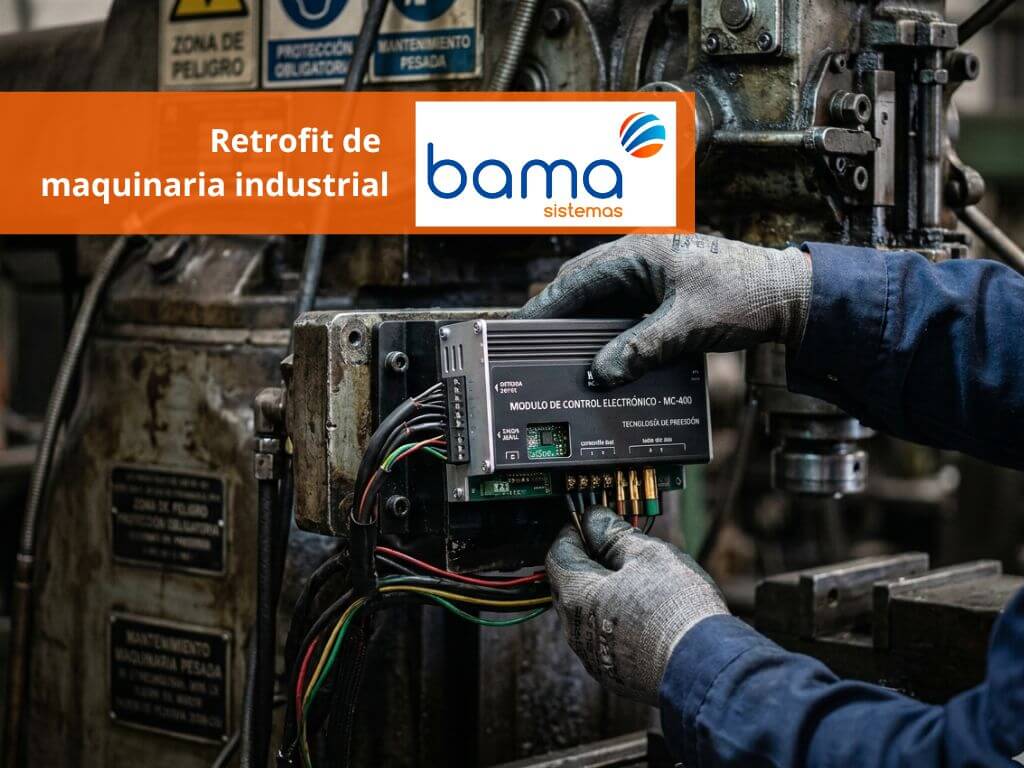
Your production line has been running for years. The mechanics hold up, the operators know it by heart, and the process is mastered. But the control system is from another era, data is not captured, and each unplanned breakdown costs hours of production that cannot be recovered. Industrial machinery retrofit exists precisely to solve that problem: modernizing the equipment’s intelligence without touching what already works well.
It is not repairing. It is not buying new. It is evolving with judgment.
What Is Industrial Machinery Retrofit
Industrial machinery retrofitting is the process of technological upgrading of mechanically functional equipment with obsolete control, communication, or safety systems. It intervenes on the equipment’s electronics, automation, and sensors, transforming it into a connected, safe asset aligned with current production standards.
Unlike a repair (which returns the machine to its previous state), machinery retrofit adds new capabilities: connectivity, real-time monitoring, integration with MES or SCADA systems, and updated regulatory compliance.
The result is a machine with the mechanical robustness it already had, but with the intelligence it was missing.
Components Modernized in an Industrial Machinery Retrofitting Process
In an industrial machinery retrofitting intervention, not all parts of the machine are addressed equally. Technologically obsolete systems are identified and replaced or integrated with current solutions. These are the three main blocks:
Control Systems: PLCs and Automation
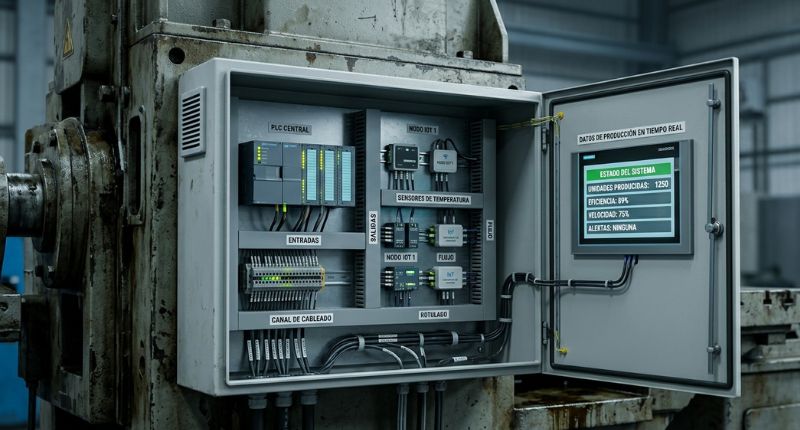
The programmable logic controller (PLC) is the brain of any automated machine. In equipment over 10-15 years old, PLCs are usually discontinued, without manufacturer support and with undocumented program logic. Retrofit replaces these controllers with latest-generation PLCs, compatible with modern industrial networks (Profinet, EtherNet/IP) and with communication capability to higher-level systems. This eliminates dependence on discontinued spare parts and opens the door to remote supervision.
IoT Sensors for Predictive Maintenance
Installing intelligent sensors on existing industrial machinery is one of the highest-impact steps. Without modifying the original PLC, it is possible to incorporate:
- Vibration sensors on motors and bearings to detect anomalies before failure.
- Temperature sensors (RTD) to identify overheating in critical systems.
- Current and power sensors that correlate energy consumption with the actual motor condition.
- Pressure and flow sensors to detect invisible leaks in hydraulic or pneumatic systems.
This data, transmitted via lightweight protocols such as MQTT, enables the shift from reactive maintenance to predictive maintenance, directly reducing unplanned downtime.
HMI Interfaces and Data Communication
Old operator screens and panels limit the operator to a local, static view of the process. Retrofit incorporates modern HMI interfaces with real-time visualization, configurable alarms, and remote access. Additionally, through Industrial Gateways, legacy protocol language (Modbus RTU, Profibus) is translated to modern cloud-ready protocols, integrating the machine into the plant’s digital ecosystem.
Benefits of Industrial Machinery Retrofitting
Modernization has no value if it does not translate into measurable plant results. Industrial machinery retrofitting directly impacts two variables that every maintenance manager and operations director monitors closely: production efficiency and investment cost.
Direct Impact on Your Plant’s OEE
OEE (Overall Equipment Effectiveness) measures availability, performance, and quality. Machinery retrofit acts on all three pillars: it reduces unplanned stops, stabilizes process conditions, and improves quality traceability. Plants that have applied this strategy report OEE improvements exceeding 15% in the first months.
CAPEX Optimization: Cost Versus New Machine
The cost of a machinery retrofit project represents between 30% and 50% of acquiring new equipment with equivalent capabilities. Added to this is the absence of a learning curve: operators already know the equipment’s mechanics. ROI accelerates and the plant does not stop for weeks to install and validate new machinery.
Challenges of Industrial Machinery Retrofitting
Industrial machinery retrofitting is not without complexity. These are the main challenges that must be managed rigorously:
- Incomplete technical documentation: Many old machines lack updated electrical schematics, requiring a thorough prior audit.
- Integration of heterogeneous protocols: The coexistence of technologies from different eras requires specialized integration engineering.
- Post-intervention regulatory compliance: Any substantial modification requires a new risk assessment, demanding legal planning from the project’s outset.
Change management in the plant: Personnel must be trained on new interfaces and procedures to maximize return on investment.
When Is Machinery Retrofit NOT the Solution?
Machinery retrofitting is not always the correct answer. There are situations where the investment is not justified:
- When the mechanical structure is irreversibly deteriorated and cannot guarantee process precision.
- When the retrofit cost exceeds 70% of the price of equivalent new equipment.
- When production needs have changed radically and the machine cannot functionally adapt, regardless of its electronics.
In these cases, total replacement is the most rational decision. A rigorous prior technical diagnosis is what makes the difference between a sound investment and unnecessary expense.
Modernize Your Industrial Machinery with Technical Judgment and Regulatory Support
Industrial machinery retrofit is not a compromise solution: it is an engineering strategy that enables industrial plants to compete with the efficiency of a new installation, without renouncing the solidity of the assets they already possess.
At Bama Sistemas, this approach translates into modernization projects where every technical decision is backed by a feasibility analysis, an integration plan, and the regulatory compliance your plant needs to operate with complete safety.
The question is not whether your machinery can be modernized. The question is whether you can afford to continue without doing so.
Is Your Industrial Machinery Slowing Down Your Plant’s Productivity?
Request a technical evaluation with BAMA Sistemas and modernize your industrial machinery without replacing your equipment.