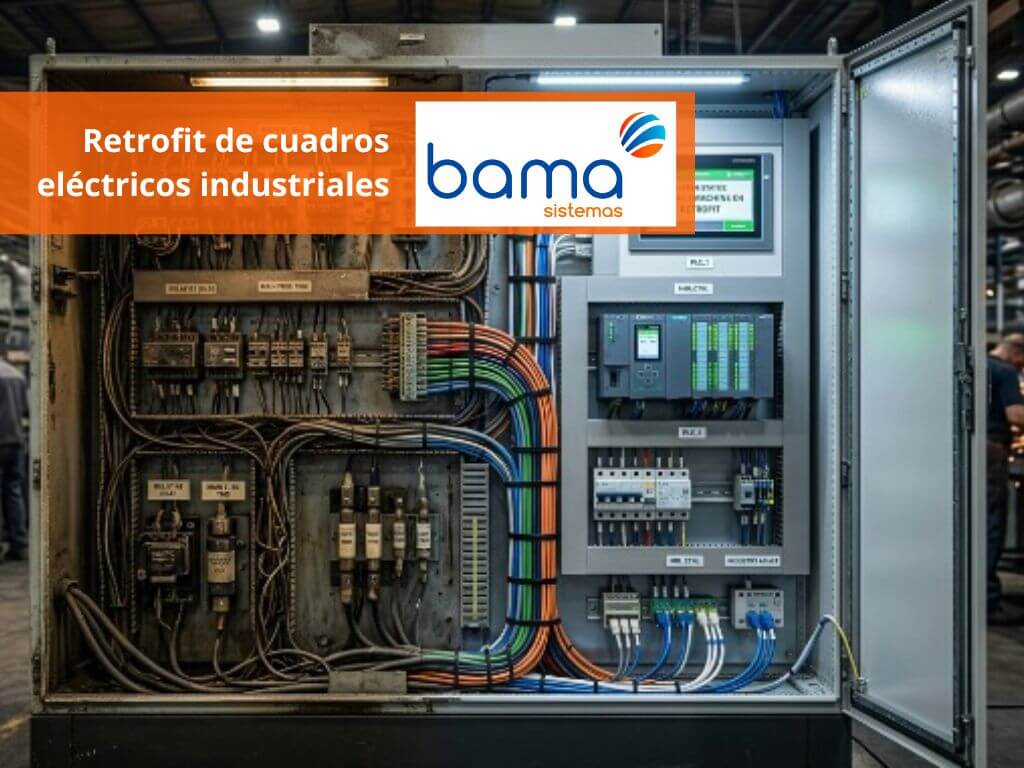
Your plant has been running for years. The lines produce, the operators work, and apparently everything is fine. But there are signs that don’t lie: intermittent failures, PLCs without manufacturer support, drives that no longer have spare parts, and an electrical panel that increasingly generates uncertainty. The problem isn’t the structure—it’s what’s inside. Electrical panel retrofit exists precisely for this: modernizing what fails without discarding what still works.
This isn’t a patch. It’s a strategic decision that delivers 80% of the benefits of a new installation with only 30-60% of the investment. And with downtime measured in hours, not weeks.
What Industrial Electrical Panel Retrofit Entails
Industrial electrical retrofit is the process of upgrading the active components of an existing electrical panel (control systems, protections, and automation) without replacing the physical structure of the cabinet.
The logic is clear: the steel enclosure and copper busbars of a panel have a service life of 30 to 40 years. However, control electronics (PLCs, relays, drives) become obsolete in just 10 to 15 years. Retrofit solves exactly that gap: it renews the brain of the panel and preserves its skeleton.
Retrofit vs. Electrical Revamping: The Difference Every Plant Manager Must Know
Both terms are frequently used in industrial environments, but they don’t mean the same thing:
| Concept | What It Involves | Downtime | Investment |
| Retrofit | Upgrade of active components while preserving the structure | Hours to days | 30-60% of total cost |
| Revamping | Broader modernization, may include structural and process changes | Days to weeks | Higher |
| Total Replacement | Completely new installation from scratch | Weeks to months | 100 % |
Industrial electrical retrofit is the most efficient option when the physical structure of the panel is in good condition and the goal is to modernize control without affecting production continuity.
Signs That Your Electrical Panel Needs an Urgent Retrofit
Ignoring the signs of an obsolete electrical panel has a real cost: unplanned downtime, production loss, and risk to personnel. These are the signs indicating it’s time to act:
- Discontinued PLCs or drives without technical support or available spare parts
- Recurring failures without clear cause or difficult to diagnose
- Absence of communication with SCADA systems or modern industrial networks
- Non-compliance with current regulations such as UNE-EN 61439 or REBT
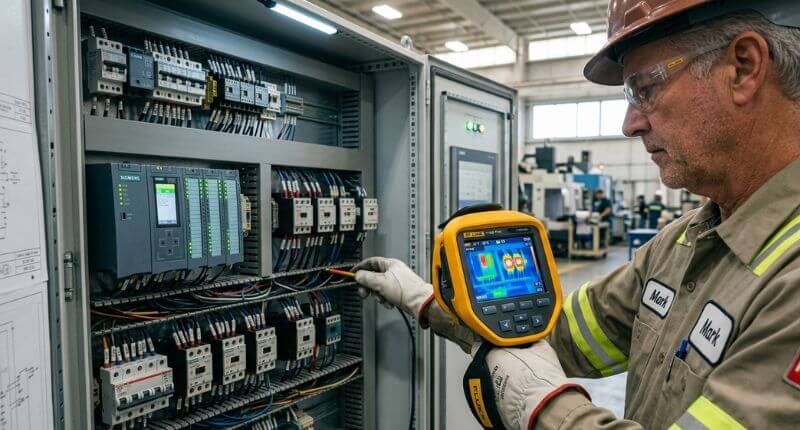
- Overheating detected in thermographic inspections
- Inability to integrate the panel into real-time monitoring systems
If your plant operates in sectors such as food, bottling, packaging, palletizing, palm oil, or packing, and you recognize any of these signs, the time to evaluate a retrofit has arrived.
What Components Are Addressed in an Electrical Retrofit?
Electrical system modernization in an industrial panel covers the elements that concentrate the greatest technological wear:
- PLCs (Programmable Logic Controllers): migration to current platforms with IEC-61131-3 standard languages and industrial connectivity
- Variable frequency drives: replacement with models featuring digital communication and greater energy efficiency
- HMI (Human-Machine Interfaces): replacement of physical panels with touchscreens offering modern process visualization
- Electrical protections: motor starters, relays, and circuit breakers upgraded to digital technology with remote diagnostic capability
- Communication systems: integration into industrial networks such as Profinet, EtherNet/IP, or Modbus for connectivity with SCADA and IIoT
- Wiring and labeling: organized rewiring with EMC criteria, proper shielding, and separation of power and control signals
For upgrading open-frame circuit breakers, three technical adaptation levels exist: Direct Replacement (DR), Cradle in Cradle (CiC), and Hard Bus Retrofill (RF), each applicable depending on the condition of the original installation.
Benefits of Electrical Retrofit: Profitability, Safety, and Sustainability
A well-executed electrical retrofit project generates impact in three dimensions:
Economic
- Investment between 30% and 60% compared to a new installation
- Reduction in operational maintenance costs between 25% and 40%
- ROI achievable in 1 to 3 years depending on installation size
Operational and Technical
- Real-time fault diagnosis through IoT sensors and infrared thermography
- Integration with predictive maintenance (PdM) and GMAO systems
- Extension of asset service life by an additional 15 to 30 years
Environmental
- Estimated savings of up to 40 tons of CO₂ per large-scale project by avoiding the manufacture of new assets
- Alignment with circular economy principles and industrial sustainability objectives
Electrical System Modernization: Every Day You Wait Has a Price
The question isn’t whether your electrical infrastructure needs an upgrade. The question is how much each day you don’t do it is costing you. An obsolete electrical panel doesn’t just represent a technical risk: it’s a direct barrier to the efficiency, competitiveness, and safety of your plant.
Industrial electrical panel retrofit is the smartest way to modernize without stopping what already works. At BAMA Sistemas, we design, implement, and execute complete industrial electrical retrofit projects: from initial technical diagnosis to commissioning, with full command of PLCs, HMI, drives, wiring, and programming.
Want to know which components of your panel need intervention and how much it might cost?
Request your quote with BAMA and receive a technical evaluation tailored to your production process.