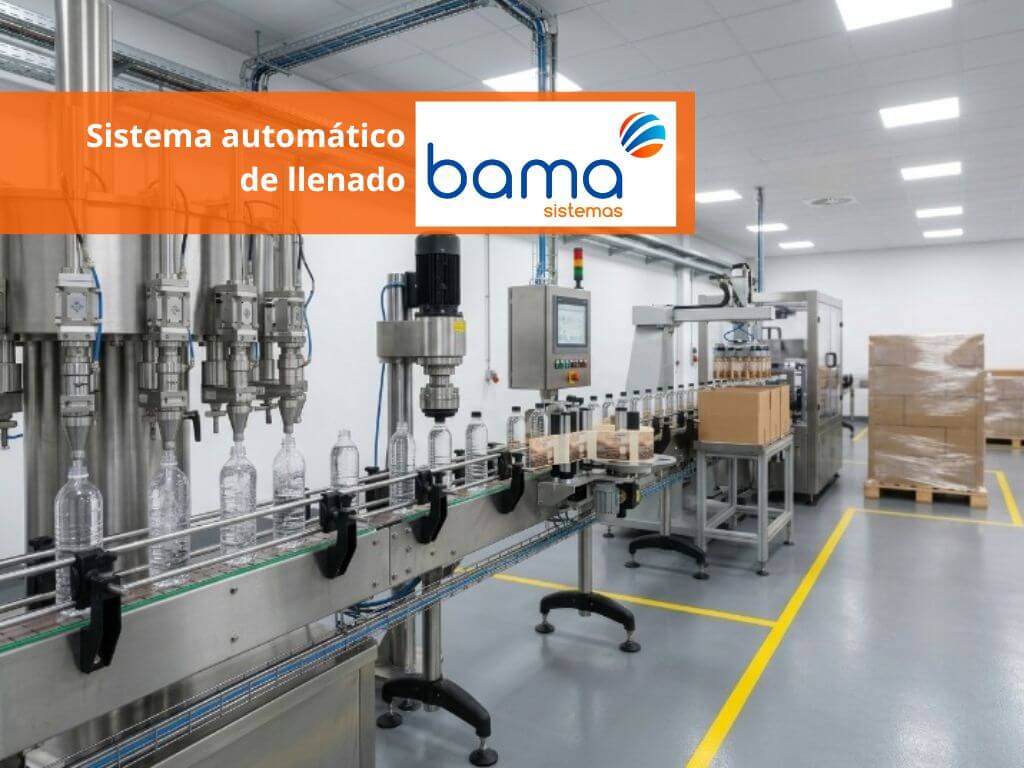
When an operations director seeks an automatic filling system, they rarely need just one machine. What is truly at stake is the profitability of an entire production line: every second of invisible downtime, every liter spilled, and every poorly optimized cleaning cycle translates into margins that evaporate without the monthly report reflecting it.
If your plant works with liquids (whether oil, wine, beer, or a cosmetic product) and you feel you are producing less than your facility should allow, the problem is probably not in a single machine. It is in how all the stages communicate (or do not) with each other. This is where the integration of a complete system makes the difference between a factory that functions and one that competes.
What is an automatic filling system (and why it is not just a machine)
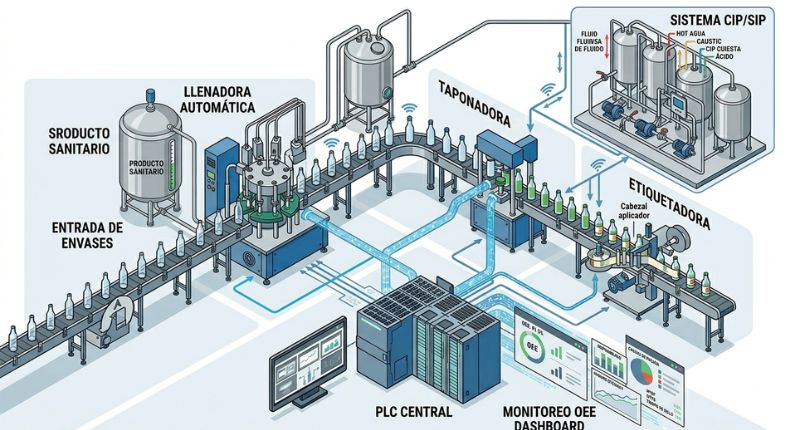
An automatic filling system is a synchronized set of equipment—filler, capper, labeler, CIP/SIP system, and end-of-line—governed by a central PLC and connected through industrial communication protocols such as IO-Link or OPC UA.
When you purchase machines separately, each unit operates with its own logic. When you integrate a complete system, a single brain controls the speeds, detects micro-stops in milliseconds, synchronizes automatic restarts, and keeps OEE (Overall Equipment Effectiveness) under permanent surveillance. That visibility is what separates plants that believe they are efficient from those that truly are.
The key stages of an automatic filling and packaging line
A well-designed automatic filling and packaging line is a chain where each link depends on the previous one. These are the critical stages that every integration project must consider.
Automatic bottle filler
The automatic bottle filler is the equipment that dictates the pace of the entire plant. Its dosing technology (volumetric, net weight, or vacuum) is selected based on the product: low-viscosity liquids such as water or wine work well with gravity; denser ones such as sauces or gels require piston or mass flow. Advanced sensors (load cells, flow meters) automatically compensate for thermal variations that alter viscosity, eliminating calibration errors that are inevitable in manual processes.
Capping and labeling
Immediately after filling, the container advances to the capping and labeling stations. Here, RFID technology and machine vision enable semi-automatic format changes: the machine recognizes the bottle type and adjusts parameters without manual intervention, reducing setup times that directly attack the availability factor of OEE.
CIP/SIP cleaning
In sectors such as food or pharmaceutical, the CIP (Cleaning In Place) system is not a “necessary evil”; it is a lever for availability. Its effectiveness depends on the balance between four variables of Sinner’s Circle: time, temperature, chemical action, and mechanical action (turbulent flow of 2 to 3 m/s). In GMP environments, CIP is the mandatory precursor to SIP (Sterilization In Place), which guarantees asepsis through clean steam at 121°C. A poorly designed CIP not only compromises hygiene: it steals hours of production every day.
Sectors that demand filling automation with no margin for error
Automatic packaging has different requirements depending on the industry, and an integrator must master them all:
- Food and beverages (oil, wine, beer, spirits, juices): food regulations, materials certified for food contact, vacuum filling to preserve shelf life.
- Pharmaceutical: GMP compliance, complete traceability, micrometric precision, and controlled environments.
- Cosmetics: precise dosing to minimize waste and guarantee the presentation of the final product.
- Chemical and cleaning: material compatibility with corrosive substances, ATEX certification for explosive atmospheres.
Each sector requires a specific configuration of sensors, materials, cleaning protocols, and regulations. There is no “standard system” that works for everyone.
Filling line automation: implement, upgrade, or maintain your system
Filling line automation is not a single project; it responds to three real scenarios:
- New implementation: design, PLC programming, integration of all modules, and commissioning of a complete line from scratch.
- Retrofit or upgrade: your line exists but needs to incorporate IoT sensors, real-time OEE monitoring, CIP automation, or new stages such as automatic labeling.
- Maintenance and optimization: adjust line balancing (V-Curve) to recover between 2% and 5% of performance without investing in new equipment, or implement predictive maintenance with AI to anticipate failures.
In all three cases, the result depends on a factor that many plants underestimate: who designs, programs, and integrates the entire system.
Why the integrator defines the success of your automatic filling system
Buying a catalog filler is easy. Making it work synchronized with the rest of the line, ensuring that data from each sensor reaches the PLC in milliseconds, that the CIP does not steal productive time, and that the OEE reflects the reality of the plant—that requires an integrator with experience in complex projects.
BAMA Sistemas has over 20 years of experience designing and implementing turnkey industrial automation solutions in sectors such as food, pharmaceutical, cosmetics, and chemicals. We do not sell machines: we integrate complete systems, from process analysis to maintenance, covering the entire value chain.
Is your filling process limiting production capacity?
Speak with BAMA Sistemas specialists and find the right automation solution to reduce downtime, optimize resources, and increase the productivity of your filling line.