
Imagine losing control of your production line for hours without knowing what failed, where, or why. Every minute of unplanned downtime is money lost, delayed orders, and eroding trust. If you manage an industrial plant and feel like you’re making decisions blindly, without reliable data or real-time visibility, SCADA systems are exactly what you need to regain control.
In this article, BAMA Sistemas clearly and practically explains what a SCADA system is, how it works, its components, existing types, and how it can transform your company’s operations. Because understanding this technology is the first step to stop reacting late and start anticipating.
What is a SCADA system and what is its purpose in industry?
A SCADA system is a platform that combines SCADA software and hardware to monitor, control, and acquire data from industrial processes in real time. Its acronym stands for Supervisory Control and Data Acquisition.
In practical terms, a SCADA acts as the nerve center of your plant: it collects information from sensors and equipment distributed throughout the facility, processes it, presents it visually on control screens, and allows remote action on processes. You no longer depend on manual rounds or delayed notifications.
Its main function is to offer complete visibility into what is happening in your facility so that production, maintenance, and engineering can work with real data, make informed decisions, and prevent unexpected shutdowns.
SCADA meaning and technical definition
From a technical standpoint, a SCADA is an industrial control system capable of interacting with field devices (such as sensors, actuators, PLCs, and RTUs) and centralizing information for analysis, visualization, and alarm management. It is the supervisory layer that connects the physical world of the plant with operational decision-making.
SCADA Architecture: How the System is Structured
The SCADA architecture is organized into three hierarchical levels that ensure reliable communication between the physical environment and the supervisory system. Understanding this structure is fundamental to assessing how it fits into your facility.
1. Field Level (sensors and actuators)
This is the system’s foundation. Here are the sensors that measure critical variables such as temperature, pressure, flow, or level, and the actuators that execute physical actions such as opening valves or starting motors. Without this level, there is no data to supervise.
2. Control Level (PLCs and RTUs)
Programmable Logic Controllers (PLCs) and Remote Terminal Units (RTUs) process the information received from the field and execute control commands. They are the bridge between what happens on the plant floor and the supervisory system.
3. Supervisory Level (SCADA software and HMI)
This is where the operator interacts with the system through Graphical Interfaces (HMI). The SCADA software displays real-time data, manages alarms, records historical data, and allows remote control. This is where data is converted into decisions.
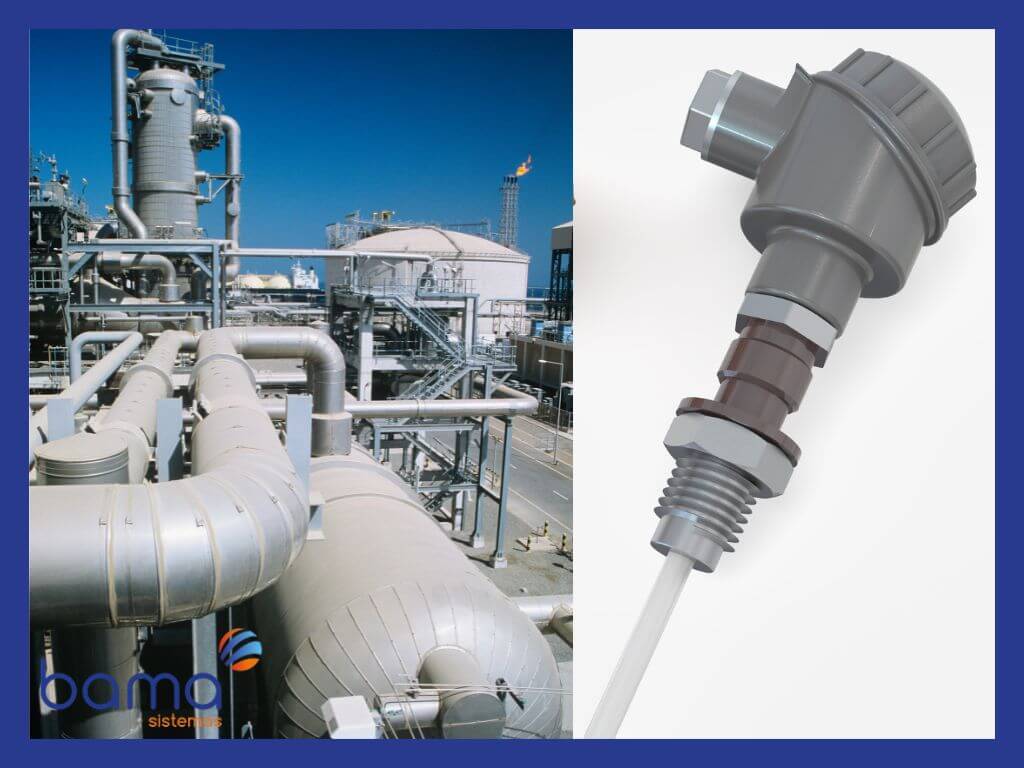
Example of an RTU (Remote Terminal Unit) with a thermocouple: a device used in large industries, such as refineries, that transmits electronic signals to an MTU (Master Terminal Unit). Its function is to measure the temperature of various processes and send the data to the control panel for real-time monitoring and analysis.

Components of a SCADA System
Knowing the components of a SCADA system will help you understand what you need to implement it in your plant. Each piece fulfills a specific function within the ecosystem.
Master Terminal Unit (MTU)
It is the brain of the system. It can be a server or a central computer that collects, stores, and processes data sent from the field. All communication with remote devices is managed from here.
Remote Terminal Units (RTUs)
Field-installed devices that collect data from sensors and transmit it to the MTU. In modern systems, PLCs also perform this function, offering greater local processing capacity.
Human-Machine Interface (HMI)
The control screen every operator needs. It allows visualizing the status of processes, interpreting alarms, consulting historical data, and acting on equipment intuitively. A good HMI design makes the difference between detecting a problem in time or discovering it too late.
Industrial communication network
Connects all system elements using industrial protocols such as Modbus, OPC UA, Profibus, or MQTT. It can be wired or wireless, and its reliability is key for data to arrive without interruptions.
How a SCADA system works step by step
The operation of a SCADA system follows a continuous and automated cycle. Field sensors capture process variables and send them to PLCs or RTUs. These controllers process the information and transmit it through the communication network to the central server. There, the SCADA software analyzes the data, compares it with predefined values, and displays it on the HMI screens. If it detects a deviation or anomaly, it generates automatic alarms so that the operator can act immediately or the system itself can execute corrective actions.
This cycle repeats in milliseconds, ensuring constant supervision that eliminates blind spots in your operation.
Types of SCADA systems according to their architecture
Not all SCADA systems are the same. Their technological evolution has generated different types that adapt to various industrial needs. Understanding these differences will help you assess which type best fits your plant’s current reality and where you need to scale.
Monolithic SCADA
This is the first generation of SCADA systems, typical of installations designed in the 80s and 90s. It operates completely isolated, without connection to other networks, with all resources centralized on a single computer or server. Communication protocols are proprietary, making integration with devices from other manufacturers difficult. Its main limitation is scalability: expanding the system implies costly and complex changes. If your plant still operates with a monolithic SCADA, you are likely assuming risks of obsolescence, lack of technical support, and vulnerability to single-point failures.
Distributed SCADA
It emerged to solve the limitations of the monolithic model. In this type, control and supervisory functions are distributed among several servers and stations connected in a local area network (LAN). This significantly improves redundancy: if one piece of equipment fails, the rest of the system continues to operate. It allows real-time information sharing between different areas of the plant and facilitates centralized alarm and historical data management from multiple access points. It is a common architecture in medium and large plants that need reliability without depending on a single control point.
Networked SCADA
Based on open architectures and standard protocols such as OPC UA, Modbus TCP, or MQTT, this type of SCADA facilitates communication between devices from different manufacturers and integration with other systems such as MES, ERP, or data analysis platforms. Its main advantage is flexibility: you can incorporate new equipment, sensors, or modules without redesigning the entire infrastructure. Additionally, it allows secure remote access via WAN or VPN networks. It is the most common choice in modern industrial environments that require interoperability and are undergoing digitalization.
Cloud-based SCADA
The current trend and the natural bridge to Industry 4.0. It eliminates the need for dedicated local servers, moving data processing and storage to cloud platforms. It allows secure remote access from any device with an internet connection, integrates natively with IoT technologies, and offers virtually unlimited scalability without large investments in physical infrastructure. Its payment model is usually subscription-based, which reduces the barrier to entry for companies that want to start with a controlled scope and expand later. The main challenge remains ensuring cybersecurity and communication latency with field devices.
Applications of SCADA systems in industry
Industrial automation has brought SCADA systems to practically all productive sectors.
- Energy and electrical distribution: Monitoring and control of energy flow, fault detection, and adjustments in electrical grids.
- Food industry: Production supervision, temperature and humidity control, and processing equipment management.
- Oil and gas: Control of oil platforms and refineries to ensure safety and efficiency.
- Manufacturing: Optimization of production processes and improvement of product quality.
- Water treatment: Monitoring water levels, flow, and other parameters in treatment plants.
SCADA systems advantages and disadvantages
Before deciding to implement a SCADA, it’s important to know both sides. Here is an honest analysis of the advantages and disadvantages of SCADA systems that you should consider.
Key advantages for your company
- Total real-time visibility: you know what’s happening at every point in your plant at all times.
- Reduced downtime: early fault detection allows action before costly breakdowns occur.
- Operational cost savings: fewer corrective interventions, lower energy consumption, and better resource utilization.
- Data-driven decision-making: historical data, trends, and analyses that support every decision.
- Remote control: manage your plant from any location without relying on constant on-site personnel.
Disadvantages and limitations to consider
- Significant initial investment: hardware, software, integration, and training require a budget.
- Implementation complexity: requires custom design and specialized professionals for configuration.
- Cybersecurity vulnerability: being connected to networks, it requires robust cybersecurity measures.
- Technological dependence: a failure in the communication network can affect supervision if there is no redundancy.
- Continuous maintenance: software updates, sensor calibration, and security protocol review.
SCADA vs. HMI and DCS: key differences
It is common to confuse these concepts. An HMI is just the graphical interface that allows the operator to interact with the process; it is a component of SCADA, not a substitute. A DCS (Distributed Control System) is designed for continuous control of complex processes in a single plant, while SCADA excels in supervising geographically distributed facilities and centralized data acquisition. If your main need is to monitor and control multiple points from an operations center, SCADA is your tool.
How to choose the right SCADA system for your plant
If you are in the research phase, these are the key questions you should ask yourself before choosing:
- How many variables do you need to monitor? Define the actual scope of your installation.
- Do you require remote access? Evaluate cloud-based solutions or secure web access.
- What systems should it integrate with? Ensure it is compatible with your current PLCs, ERP, or MES.
- What level of cybersecurity do you need? Assess the risks according to your sector and applicable regulations.
- Who will support you in the implementation? Having a specialized partner like BAMA Sistemas makes the difference between a successful project and one that creates more problems than it solves.
The cost of not having a SCADA you are already paying
SCADA systems are no longer an exclusive technology for large corporations. They are the foundation upon which any industrial company in Spain can build a more efficient, safer, and more profitable operation. Every day your plant operates without real-time visibility is a day you assume risks that you could avoid.
At BAMA Sistemas, we design and implement industrial automation solutions tailored to the real needs of your plant. If you are considering taking the step towards a SCADA, we will support you from analysis to commissioning.
We hope you found this article of interest.
If you require additional information to implement SCADA systems and automation with robots, do not hesitate to contact us.