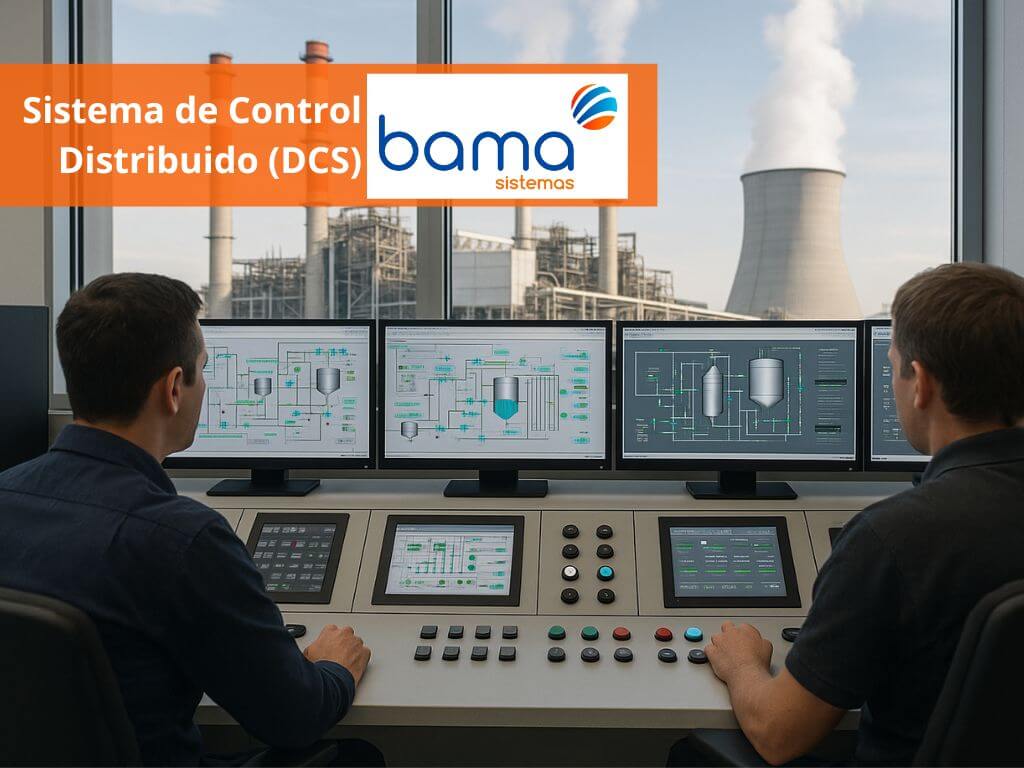
Advances in industrial automation have made it essential to use robust, efficient solutions to control complex processes. Among these, the Distributed Control System (DCS) stands out for its ability to coordinate industrial operations precisely, safely, and at scale. This article takes an in-depth look at what a DCS is, how it works, its key components, advantages, industrial applications, and the technology trends shaping its evolution.
What a DCS is in automation and how it has evolved
A DCS (Distributed Control System) is an automation system that distributes control across multiple nodes or controllers throughout a plant, rather than centralizing it in a single device. This approach improves fault tolerance, reduces wiring, and enables greater scalability.
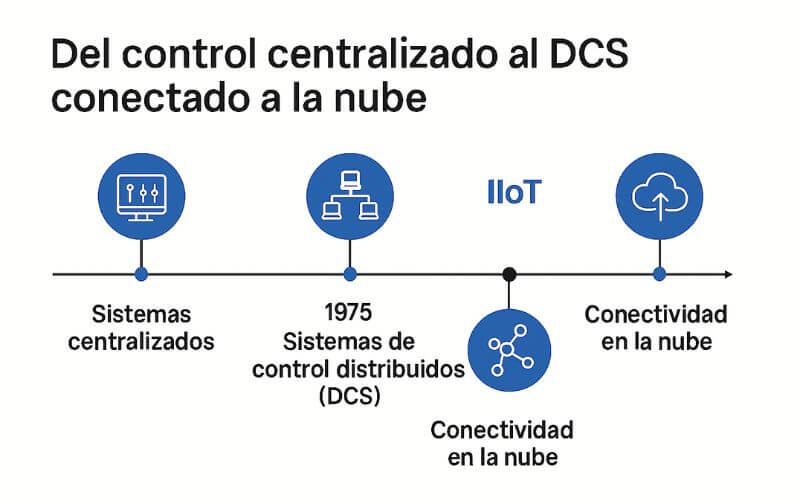
The first automation systems were centralized, which posed high risks due to single points of failure. From the 1970s onward, with the advent of microprocessors, the first commercial DCSs emerged. Since then, their evolution has been driven by digitalization, the adoption of industrial Ethernet, integration with MES/ERP systems, and, more recently, convergence with the cloud and artificial intelligence.
Architecture and levels of a distributed control system (DCS)
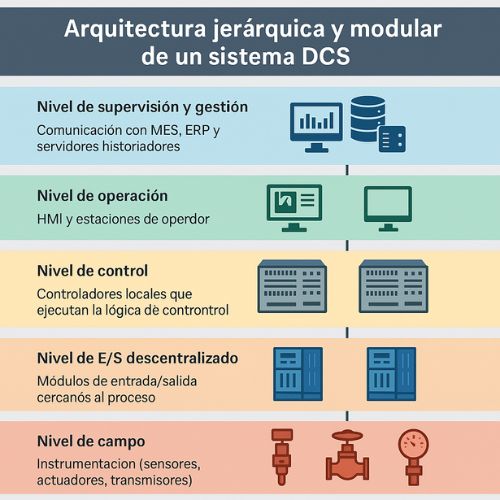
A DCS architecture is hierarchically organized into functional levels:
- Field level: Instrumentation (sensors, actuators, transmitters).
- Decentralized I/O level: Input/output modules close to the process.
- Control level: Local controllers that execute the control logic.
- Operations level: HMI and operator stations.
- Supervision and management level: Communication with MES, ERP, and historian servers.
How does a DCS work in an industrial plant?
The DCS distributes control tasks among multiple local controllers. Each one collects sensor data, processes control algorithms (such as PID), and actuates final devices. Information flows through industrial networks to HMI stations, where operators monitor and intervene when necessary.
Thanks to this configuration, a DCS can handle hundreds of thousands of variables in real time, providing a stable and flexible environment for decision-making.
Comparison: DCS vs PLC vs SCADA
Below is a comparison table with the main characteristics of each system:
| Feature | DCS | PLC | SCADA |
|---|---|---|---|
| Process type | Continuous and complex | Discrete or batch | Geographically distributed |
| Typical application | Refineries, chemical plants, power generation | Machinery, assembly lines | Pipelines, power grids |
| Architecture | Distributed | Centralized (although it can be modular) | Centralized with multiple remote nodes |
| Supervision | Integrated into the platform | Limited or with external SCADA | High, focused on remote visualization |
| Scalability | High (from units to complete plants) | Medium | High |
| Redundancy | High (controllers, networks, servers) | Limited depending on configuration | High, depends on the design |
| Initial cost | High | Medium-low | Variable |
| Maintenance | Requires specialized personnel | Simpler | Medium, depends on the system |
While a PLC is faster for specific tasks and SCADA provides remote visualization, a DCS offers an end-to-end control and supervision solution with high availability.
Benefits and limitations of a DCS
Advantages:
- High availability (full redundancy).
- Vertical integration from the field level to ERP.
- Less wiring and greater scalability.
- Advanced graphical interfaces and unified alarms.
- Advanced control capability (cascade, multivariable, adaptive).
Limitations:
- High initial cost.
- Requires specialized personnel.
- Less flexibility for urgent local changes.
- Vendor dependency (proprietary hardware/software).
Typical applications of industrial DCS
A DCS is implemented mainly in industries where continuity, safety, and quality are critical:
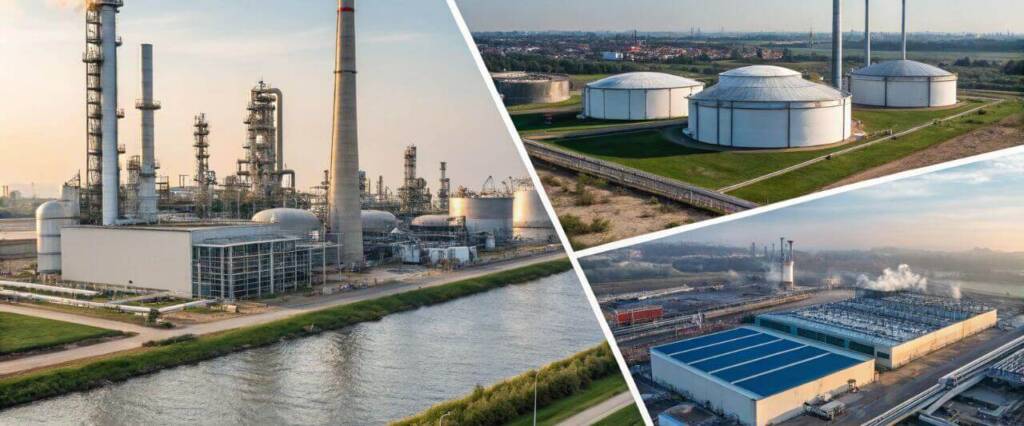
- Refineries and petrochemicals: They use DCSs to control units such as distillation columns, reformers, and cracking systems. Precise coordination among multiple process variables maximizes yield, ensures the quality of derived products, and guarantees operational safety in highly demanding environments.
- Chemical/pharmaceutical industry: In these industries, a DCS enables precise execution of recipes and batch process sequences. Its full traceability, alarm management, and regulatory compliance (such as GMP and FDA) make it essential for ensuring product quality and successful audits.
- Power generation: In thermal or nuclear power plants, the DCS controls critical processes in real time, such as boiler combustion, turbine regulation, and emissions control. High availability is essential to maintain continuous generation and respond quickly to any operational deviation.
- Water treatment: A DCS enables end-to-end supervision of processes such as filtration, sedimentation, chemical dosing, and flow control. It also ensures that water quality parameters comply with environmental regulations, with historical records for analysis and auditing.
- Mining and metallurgy: In mineral processing plants, the DCS centrally regulates equipment such as mills, flotation cells, and furnaces. Its robustness enables operation in harsh environments, optimizing mineral recovery and the process’s energy efficiency.
Is it suitable for your organization?
Choosing a DCS depends on factors such as:
- Plant size and process complexity.
- Availability and safety requirements.
- Available budget.
- The technical capability of the team.
For critical processes and environments with multiple interdependent variables, a DCS is usually the most robust and scalable option.
Decision time: are you ready for the change?
Collaborative robotics not only represents a technological evolution, but also a revolution in the way work is done. Collaborative robots offer a unique combination of safety, efficiency, and adaptability that makes them strategic allies for industrial companies.
A strategic step toward industrial efficiency
Adopting a distributed control system is not simply a technological matter, but a strategic decision. In industries where precision, availability, and data integration are differentiating factors, the DCS emerges as the ally that transforms traditional operations into a modern, connected, and resilient industrial environment. Organizations that commit to this architecture today will be taking a firm step toward sustained efficiency and future competitiveness.
Do you need a distributed control system for your plant?
Low-Medium