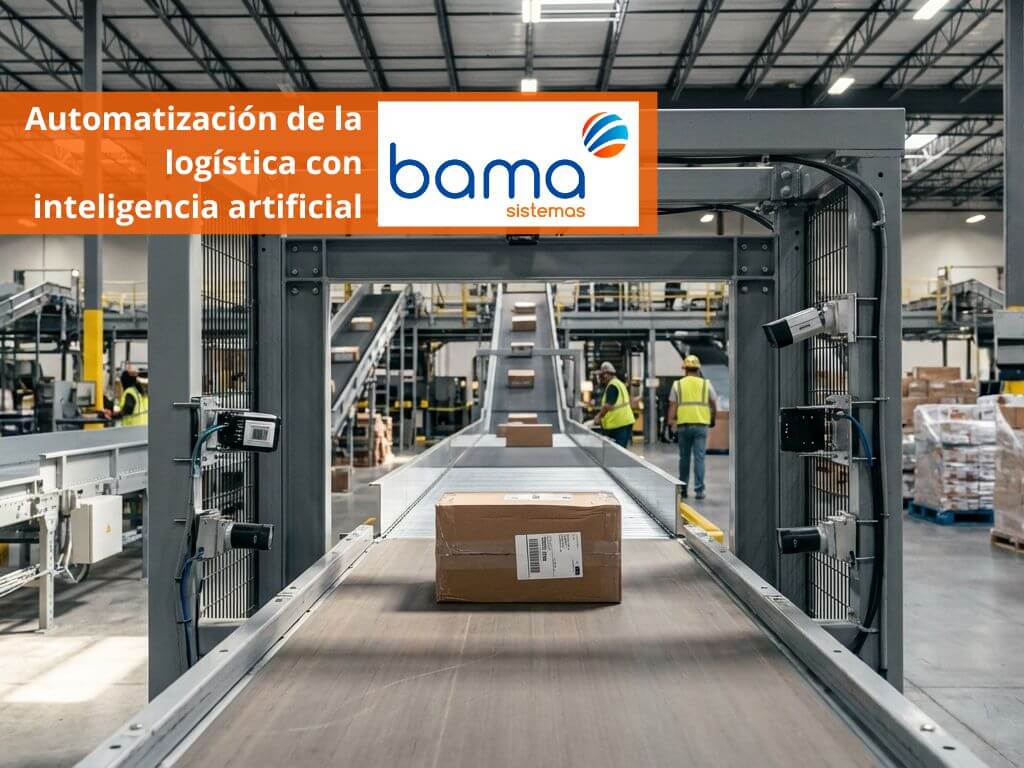
The pressure to increase throughput, reduce errors, and scale operations without multiplying costs has made artificial intelligence in logistics a strategic pillar for any modern distribution center—especially in parcel sorting, where variability in formats, volumes, and destinations demands systems that can adapt in real time.
Today, it is not only about automation, but about giving the system decision-making capability. In this article, we analyze what AI applied to sorting really is, how it works technically, and how to design a viable project from an industrial perspective.
What logistics automation with artificial intelligence involves
Artificial intelligence in logistics applied to parcel sorting integrates machine vision, machine learning algorithms, and industrial automation systems capable of analyzing physical and digital information in real time to make highly accurate automated decisions. It is not limited to automating movements; it interprets data, detects patterns, and continuously optimizes operational performance.
AI in logistics for parcel sorting transforms a traditional line into an intelligent infrastructure that identifies each unit, interprets dimensions, destination, and label status, and decides the best action without constant manual intervention. Unlike rule-based automation, these models evolve with historical and operational data.
In logistics sorting, this means:
- Recognizing dimensions, weight, and shape with advanced machine vision.
- Reading damaged or partially obscured labels using intelligent OCR.
- Detecting inconsistencies in postal codes or incomplete addresses.
- Identifying overlapping or mispositioned parcels on the conveyor.
- Determining the optimal grip point for robotic systems.
- Adjusting operating parameters based on the actual workflow.
- Learning from incidents to reduce future errors.
The result is a system that not only executes commands, but also analyzes, interprets, and decides—raising the level of accuracy and efficiency in the logistics operation.
What benefits AI brings to logistics sorting
An intelligent sorting system transforms a traditional line into an infrastructure capable of identifying each unit, interpreting dimensions, destination, and label status, and deciding the best action without constant manual intervention. In practice, this translates into:
- Recognizing dimensions, weight, and shape using advanced machine vision.
- Reading damaged or partially obscured labels with intelligent OCR.
- Detecting inconsistencies in postal codes or incomplete addresses.
- Identifying overlapping or mispositioned parcels on the conveyor.
- Determining the optimal grip point for robotic systems.
- Adjusting operating parameters based on the actual workflow.
- Learning from incidents to autonomously reduce future errors.
This integrated flow makes it possible to maintain high throughput levels with a minimal error rate. In addition, continuous learning ensures that the system progressively improves its performance, adapting to new parcel types and operational changes without the need to redesign the entire infrastructure.
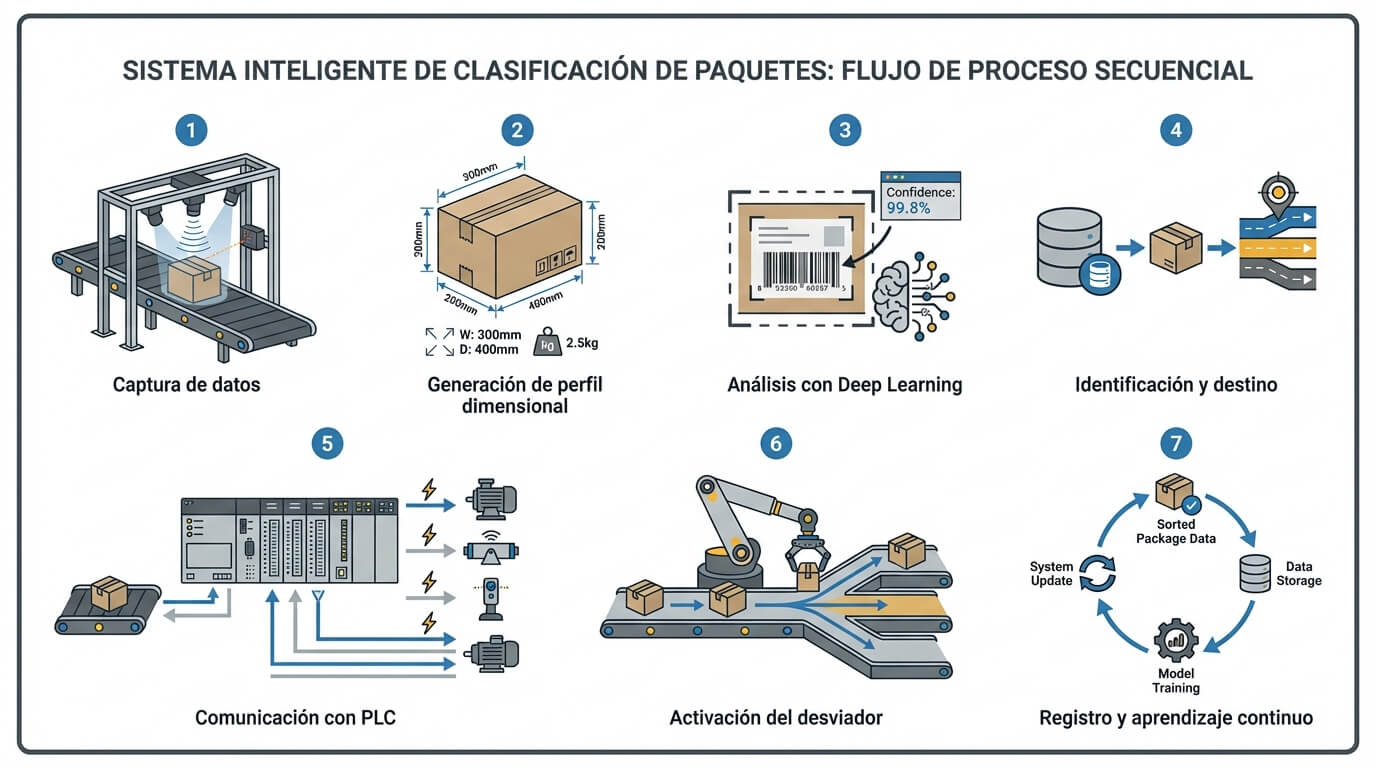
How an artificial intelligence system integrated into logistics works
An intelligent sorting system operates through a structured sequence of data capture, algorithmic analysis, and coordinated mechanical actuation. The entire process happens in milliseconds, even on high-speed lines.
- Data capture: 2D/3D cameras and sensors record the image, depth, and volumetrics of the moving parcel.
- Information preprocessing: the system generates an optimized image or point cloud ready for analysis.
- Analysis with AI models: deep learning algorithms detect the object, interpret labels, and classify the destination.
- Validation and decision: the system cross-checks the information against logistics databases (WMS/ERP).
- Industrial communication: the decision is transmitted to PLCs and control systems in real time.
- Mechanical execution: diverters, robots, or conveyors are activated to route the parcel correctly.
- Continuous learning: operational data is stored to improve the model’s future accuracy.
This integrated flow, designed and implemented by BAMA, makes it possible to maintain high throughput levels with a minimal error rate. Continuous learning ensures that the system progressively improves its performance, adapting to new parcel types and operational changes without the need to redesign the entire infrastructure.
AI technologies applied to parcel sorting
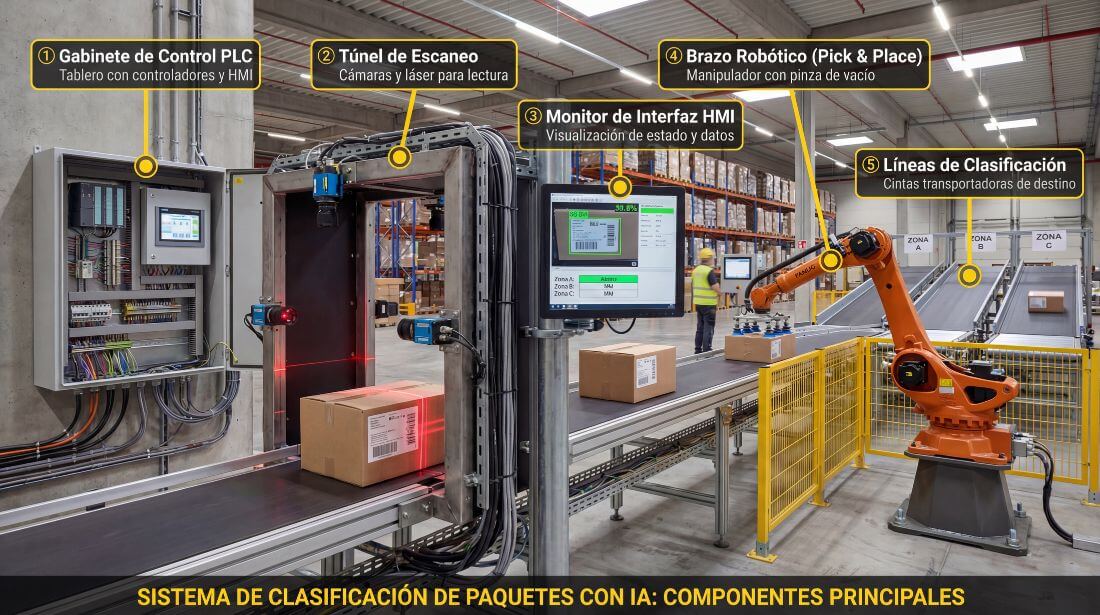
Advanced implementation of AI-based logistics automation requires a comprehensive, robust technology architecture that is perfectly synchronized across hardware, software, and control systems.
Machine vision and 2D/3D cameras
RGB-D cameras make it possible to capture:
- Color image.
- Depth.
- 3D volumetrics.
This makes it possible to identify edges, center of gravity, and optimal handling points.
Deep learning models and real-time detection
Algorithms such as YOLO or Transformer-based architectures make it possible to:
- Detect multiple objects simultaneously.
- Process video in real time.
- Interpret incomplete addresses.
Continuous learning improves performance without the need to modify hardware.
Industrial robotics and automated picking systems
Warehouse robotics integrates arms with suction cups or adaptive grippers capable of:
- Gripping irregular parcels.
- Automatically adjusting force and angle.
- Sorting up to thousands of units per hour.
Combining this with digital simulation reduces commissioning times.
Integration with PLCs, WMS, and AGVs
AI does not work in isolation. It must be integrated with:
- Industrial PLCs.
- WMS systems.
- AGVs for internal transport.
- Shuttle systems and stacker cranes.
Interoperability is key to ensuring operational continuity.
Conventional automation vs. AI systems: key differences
Traditional automation works well when variables are stable. However, when faced with deformable polybags, damaged labels, irregular parcels, or extreme SKU variability, rule-based systems fail. The AI systems integrated by BAMA learn to handle exceptions and progressively improve their accuracy:
| Scenario | Conventional automation | AI system (BAMA) |
| Deformable polybag | Does not detect edges or dimensions correctly | Identifies irregular shape using 3D vision and adjusts the grip |
| Damaged or wet label | Does not read the code; generates a manual incident | Intelligent OCR reconstructs partial information |
| Irregular parcel | Requires human intervention | Calculates center of gravity and optimal handling point |
| Extreme SKU variability | Requires reprogramming for each new format | Learns new formats without modifying hardware |
| Overlapping parcels | Read error or jam | Segments and processes each unit independently |
| Sudden volume spike | Line saturation, increased errors | Dynamically redistributes load between lines |
| Overall error rate | 3%–8% in complex operations | Below 1% with continuous learning |
Why implement artificial intelligence in parcel-sorting logistics with BAMA
Implementing artificial intelligence in parcel sorting is a strategic decision that directly impacts competitiveness, operational efficiency, and business scalability. It is not only about technology, but about coherently integrating multiple industrial disciplines within a single project.
An intelligent sorting system requires:
- Mechanical engineering and special-purpose machinery development.
- Machine vision integration and advanced algorithms.
- PLC programming and optimization.
- Industrial robotics and automated systems.
- Integration with WMS, ERP, and IT systems.
- Ongoing industrial maintenance.
When these elements are managed in a fragmented way, technical risks and cost overruns increase. That is why at BAMA we approach these projects with a turnkey approach, integrating analysis, design, implementation, programming, and maintenance into a single solution. In this way, we guarantee a solid architecture, controlled commissioning, and measurable results from day one.
Do you want to implement artificial intelligence in parcel sorting at your logistics center?
Low-Medium