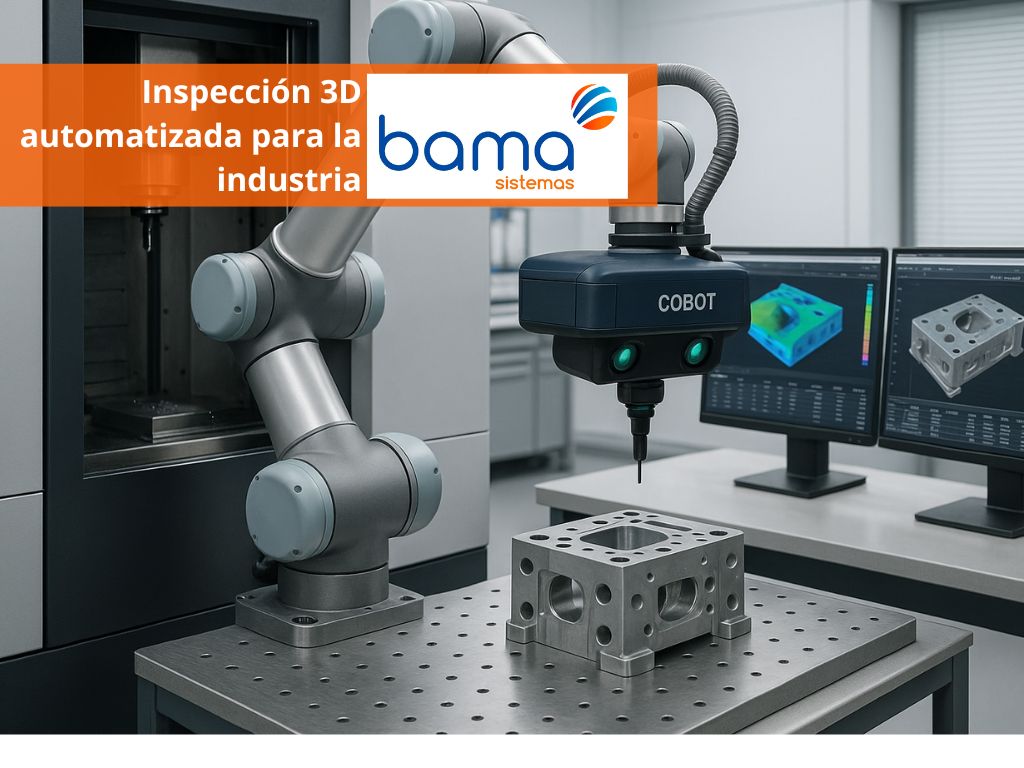
Are you exploring solutions to improve quality, traceability, and efficiency in your production line? This comprehensive guide on automated 3D inspection, developed by Bama.es—specialists in industrial robotics and process automation—is designed specifically for industrial decision-makers who want to thoroughly understand this technology before implementing it. Here you will find everything you need: types of systems, key benefits, success stories, and practical recommendations.
What Is Automated 3D Inspection?
Automated 3D inspection is a technology that combines three-dimensional sensors, machine vision, and advanced algorithms to accurately capture the geometry of parts and products without contact. Its primary objective is to detect defects, verify dimensions, and ensure product quality at any stage of the production process. Unlike manual or contact methods, it allows scanning the entire surface of an object in seconds, comparing the data with a CAD model, and making automatic decisions in real time.
Key Benefits of Automated 3D Inspection
Automated 3D inspection systems offer a competitive advantage in terms of quality control, response time, and operational efficiency.
Advanced Precision and Reliability
Current 3D scanners can detect deviations of just a few microns from the CAD model. This is crucial in sectors such as aerospace, where errors can compromise safety.
Increased Productivity and Valuable Data
In-line inspection reduces review times, avoids bottlenecks, and allows complete inspections without halting production. Additionally, the collected data is stored for traceability, audits, and continuous improvement.
Cost Savings and Efficient Equipment Use
Detecting defects early prevents rework, reduces scrap, and frees personnel from repetitive tasks. This translates into more efficient operations and lower costs associated with non-quality.
Types of Automated 3D Inspection Systems
The available technology adapts to different production environments and technical requirements.
Comprehensive Software (such as SHINING3D Inspect)
SHINING3D solutions enable point cloud analysis, measurement extraction, and automatic report generation. Ideal for metrological tasks requiring high precision.
Robotic Solutions (such as HxGN Robotic Automation)
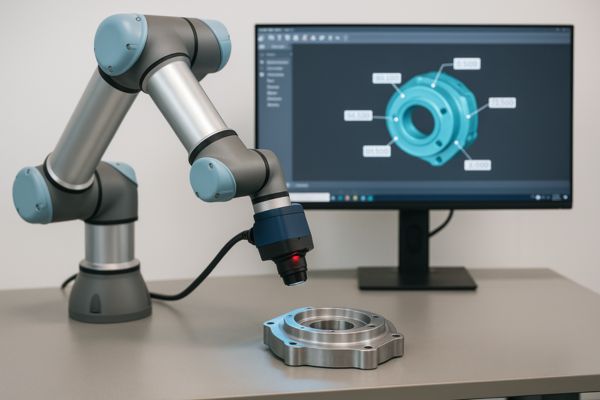
Integrate 3D scanners with robotic arms, facilitating part inspection from all angles. Widely used in automotive and foundry applications.
Independent Optical Systems (such as those from senswork)
Use static sensors and structured light projectors to scan parts quickly. Ideal for integration into continuous production lines.
How to Choose the Right 3D Inspection Technology
Choosing the right system depends on several factors: part type, production volume, required tolerances, and budget. It is also important to consider the work environment, the possibility of integration with existing systems, the need for in-line or offline inspection, and the ability to generate data for traceability.
An appropriate choice not only improves the quality of the final product but can represent a strategic advantage in terms of efficiency, resource savings, and regulatory compliance.
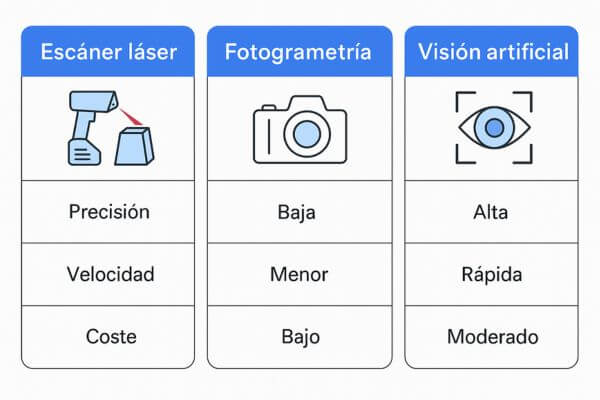
Comparison: Speed, Precision, Adaptability, Costs
- Laser scanners: High precision, good capture speed, ideal for detailed inspections on metallic or technical parts. Require higher initial investment.
- Photogrammetry: Economical and flexible solution, recommended for large objects or complex geometries. Lower comparative precision, but suitable for certain applications.
- Machine vision: Highly versatile, adapts to multiple configurations and enables real-time surface defect detection. Lower investment and rapid implementation.
Use Cases by Sector
- Automotive: inspection of chassis, welds, subassemblies.
- Aerospace: validation of structural components.
- Logistics: verification of volume and product presence.
Why Trust Bama Sistema for Your Automated 3D Inspection?
Bama Sistemas has a solid track record in the field of industrial robotics and process automation. Over the years, it has developed customized solutions for a wide range of sectors, adapting to the technical and production particularities of each client. This experience enables the delivery of efficient, robust proposals oriented toward tangible results.
Optimize Your Industrial Processes with Automated 3D Inspection
Low-Medium
Frequently Asked Questions About Automated 3D Inspection
1. What precision can automated 3D inspection achieve?
Depending on the technology, it can achieve precision from microns to hundredths of a millimeter.
2. Is it possible to inspect complex or large parts?
Yes, with photogrammetry or robotic systems any geometry can be scanned.
3. Can 3D Inspection Be Integrated into Existing Production Lines?
Yes, many solutions are designed to adapt to at-line or in-line configurations.
4. What are the approximate costs?
They vary depending on the system and level of automation, but the savings offset the investment in the short term.
5. Is Training Necessary to Operate These Systems?
Yes, but many providers offer training and technical support included.
6. What Benefits Does Migrating to Digital Signals Provide?
Greater amount of data, remote diagnostics, less wiring, and preparation for Industry 4.0.
7. What is the difference between 2D and 3D machine vision?
2D analyzes flat images; 3D captures volumetric information and allows measuring complex geometries.