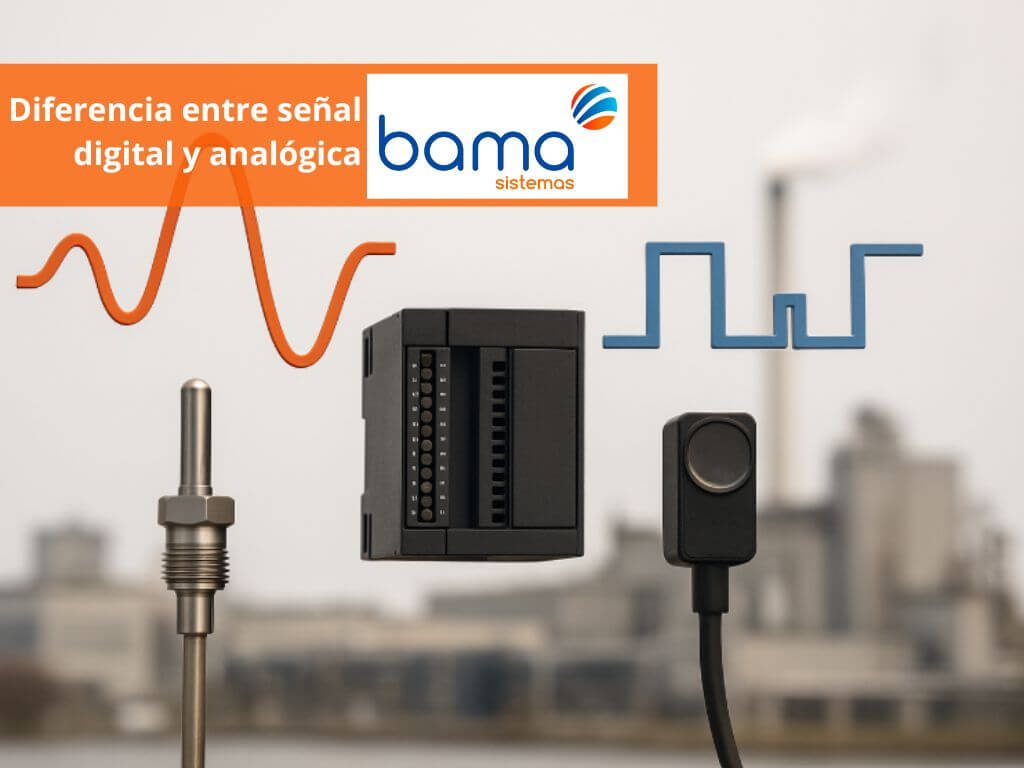
Can a 4–20 mA signal that deviates by just a few millivolts cause you to lose an entire production batch? Can a simple 1 or 0, misinterpreted, halt your entire line? The answer is yes. And that’s where it makes sense to understand, with technical discernment and an industrial focus, the difference between digital and analog signals.
It’s not just about choosing between two ways of transmitting data. It’s about reliability, preventive diagnostics, efficient integration, and real scalability. If you are evaluating how to optimize your control system or need to justify technical decisions to management, this article will serve as an objective basis. No beating around the bush, no empty jargon, just clear data.
What is an Analog Signal?
Analog signals represent physical variables using continuous values. They are used, for example, to measure temperature, pressure, or flow. An analog sensor could send a 4 to 20 mA current proportional to the measured variable.
These signals are sensitive to environmental conditions and require conditioning (filtering, amplification, isolation) before being processed by a PLC. However, they offer a direct and precise representation of the measured phenomenon.
What is a Digital Signal?
A digital signal, in contrast, transmits information in discrete form: logical states (1/0) or data encoded in bits. It can represent anything from a simple condition (on/off) to a complete numerical value in protocols like Modbus or IO-Link.
These signals are easily integrated into industrial networks and allow for advanced diagnostics, error detection, and simultaneous communication of multiple data. Furthermore, they exhibit high immunity to electromagnetic noise.
Advantages and Disadvantages: Analog vs. Digital
Understanding the strengths and limitations of each signal type is crucial for selecting the appropriate option based on the industrial application. Below are the most relevant advantages of both formats.
Advantages of Digital Signals
Digital signals provide a qualitative leap in terms of reliability, diagnostics, and integration capability. They are ideal for environments requiring traceability, maintenance efficiency, and robust network communication.
- Greater robustness against interference.
- Ability to transmit multiple data and meta-information.
- Easy error detection using checksums or CRC.
- Integration with supervision systems and predictive maintenance.
Advantages of Analog Signals
Analog signals, for their part, continue to be a practical and cost-effective solution in many industrial environments, especially when dealing with existing systems or where continuous measurement without great complexity is required.
- Simplicity of implementation (plug-and-play).
- Low initial cost per sensor.
- Universal compatibility with any PLC.
- Widely used in environments with classic infrastructure.
Applications in Industrial Automation
Modern industrial automation requires selecting the most suitable technology for each type of process. Here are the most representative cases where digital and analog signals are used.
Use Cases for Digital Signals
Digital signals are the basis of binary control and modern communication between devices. Their use is common in control tasks, safety, and punctual state sensing.
- Presence sensors (photoelectric, limit switches).
- Safety interlocks (emergency stop).
- Communication in fieldbuses with smart sensors.
Use Cases for Analog Signals
When a continuous variable, such as temperature or pressure, needs to be measured precisely, analog signals remain the most effective tool. They are indispensable in process regulation.
- 4–20 mA temperature or pressure transmitters.
- Continuous process control (PID loops).
- Measurement of physical variables with fine resolution.
Technical Comparison between Analog and Digital Signals
For informed engineering decisions, nothing beats a clear technical table. Below, the key differences between both signal types are summarized from an operational perspective:
| Attribute | Analog Signal | Digital Signal |
|---|---|---|
| Value Type | Continuous | Discrete (binary or encoded) |
| Accuracy | High, but subject to noise | High, thanks to internal processing |
| Noise Immunity | Medium (better in current) | High |
| Information Capacity | One variable per signal | Multiple data per channel |
| Initial Cost per Sensor | Low | Moderate/High |
| Integration Complexity | Low | Medium/High |
| Remote Diagnostics | Limited | Advanced (self-diagnostics, errors) |
Which to choose depending on the case?
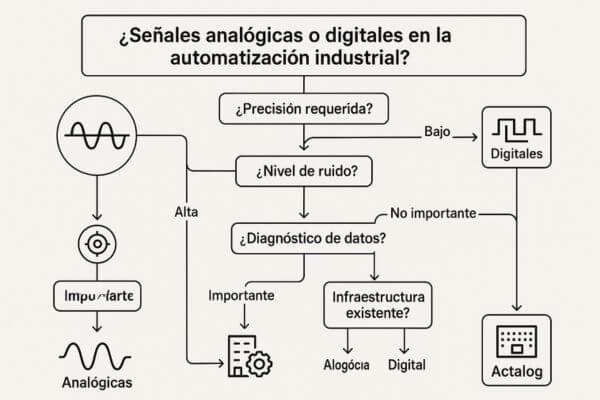
The choice between digital and analog signals depends on:
Is the installation new or an upgrade?
Is binary control or continuous measurement needed?
Is the environment prone to interference?
Is there a need for diagnostics or predictive maintenance?
What is the available budget?
Integration into Industrial Systems
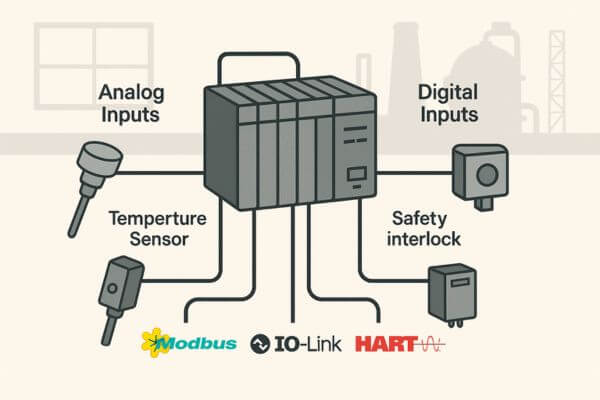
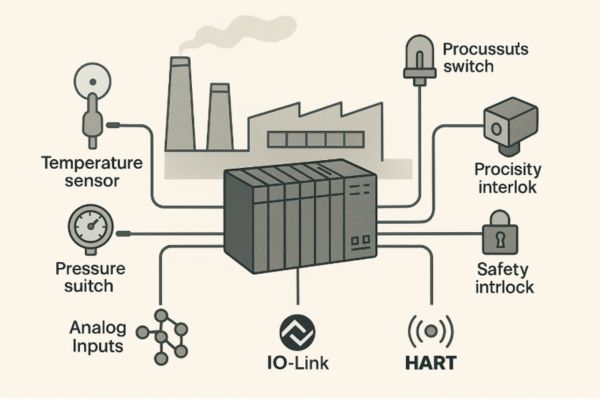
Modern systems combine both types of signals. A PLC can receive analog temperature inputs and digital safety sensor inputs simultaneously. In addition, many current solutions allow the use of mixed protocols like HART, which superimpose digital data over 4–20 mA analog signals.
This convergence allows for maintaining existing infrastructure while moving towards greater digitalization, which favors remote monitoring, traceability, and operational efficiency.
Do you need a robotic case palletizer?
Low-Medium
Frequently Asked Questions about Digital or Analog Signals
1. What is the most common standard for industrial analog signals?
The most common is the 4 to 20 mA current loop, due to its noise immunity and universal compatibility.
2. Can digital signals be used in noisy environments?
Yes, they are ideal for this. Digital protocols include error correction and detection mechanisms.
3. Can the same system mix digital and analog signals?
Absolutely. Most modern PLCs are designed to manage both types simultaneously.
4. Do digital sensors require programming?
Yes, they usually require configuration of addresses, protocols, and parameterization in the PLC or SCADA.
5. When is it advisable to maintain an analog signal?
When the infrastructure already exists, there is a low budget, or simplicity and immediate reliability are needed.
6. What Benefits Does Migrating to Digital Signals Provide?
Greater amount of data, remote diagnostics, less wiring, and preparation for Industry 4.0.
7. How can Bama Sistemas help in the transition from analog to digital signals?
Bama Sistemas supports industrial companies throughout the modernization process, from auditing current signaling to implementing mixed or 100% digital solutions. This includes sensor selection, control architecture design, and commissioning with remote diagnostics and predictive maintenance.