Do you need to decide between a PLC or a DCS and are unsure which best suits your plant? You are facing a choice that directly impacts the efficiency, scalability, and security of your operations. Choosing incorrectly can lead to unnecessary costs, control failures, or a lack of future flexibility. Choosing correctly, however, can optimize your production for years.
In this article, we offer a clear and technical comparison between both systems, based on engineering and industrial operation criteria. Furthermore, you will learn how BAMA Sistemas can help you make the best decision according to your process type, budget, and growth projections.
Key Differences between PLC and DCS in Real Industrial Environments
When an industrial plant needs to decide how to automate its processes, the differences between a PLC and a DCS are not just technical, but strategic. It’s not simply about comparing features, but about understanding how each system behaves in real-world situations, with ongoing processes, maintenance needs, downtime, and efficiency objectives. In this section, we break down the most relevant contrasts between the two, with a practical approach that helps in making decisions based on the reality of the operating environment.
System Architecture: Centralization vs. Hierarchical Distribution
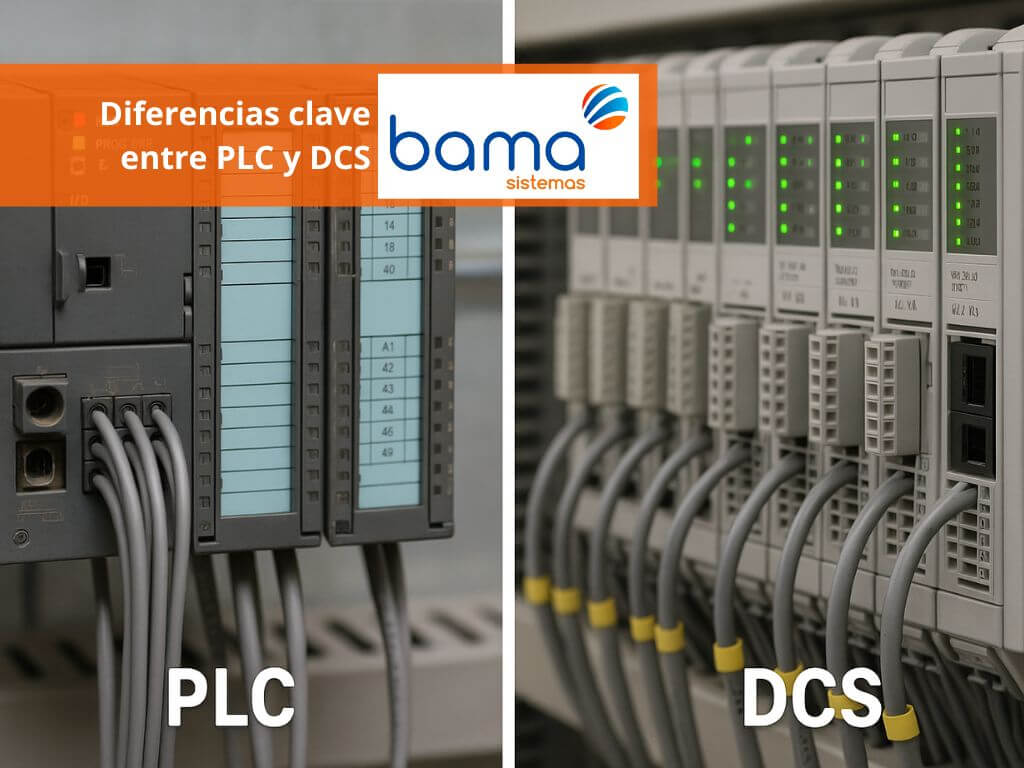
The PLC is based on a centralized architecture: a CPU directly controls locally connected inputs and outputs. In contrast, the DCS operates with a hierarchical and distributed structure, with multiple controllers interconnected via fieldbuses, allowing for more granular and fault-tolerant control throughout the plant.
Scalability and Geographical Distribution of Control
PLCs are designed to control individual processes or machines. If the plant grows, it is necessary to integrate multiple PLCs, which can increase complexity. The DCS, on the other hand, is built for scalability: its distributed nature allows managing thousands of geographically dispersed signals from a single platform.
Redundancy, Operational Reliability, and Process Criticality
The DCS incorporates redundancy by design in CPUs, power supplies, and communications. This makes it the best option for critical 24/7 processes. PLCs can incorporate redundancy, but at a high cost and usually as an additional option.
Response Time and Plant Performance
The PLC stands out for its speed: scan times of 1-10 ms make it ideal for high-speed processes, such as motor control or robotics. The DCS works with cycles of 100-500 ms, optimized for continuous processes with multiple control loops.
Integration with SCADA, HMI, MES, and Other Levels
The DCS is designed to integrate directly with supervisory (SCADA), manufacturing execution (MES), and planning (ERP) systems, forming a cohesive vertical structure. The PLC, although it can connect, usually requires external integration to reach these levels.
Implementation, Maintenance, and Scaling Costs
For simple applications, the PLC is more economical in terms of initial investment. However, the DCS can be more cost-effective in large projects due to its native integration, reduced need for additional programming, and advanced diagnostic tools.
Advantages and Limitations of Each Control System
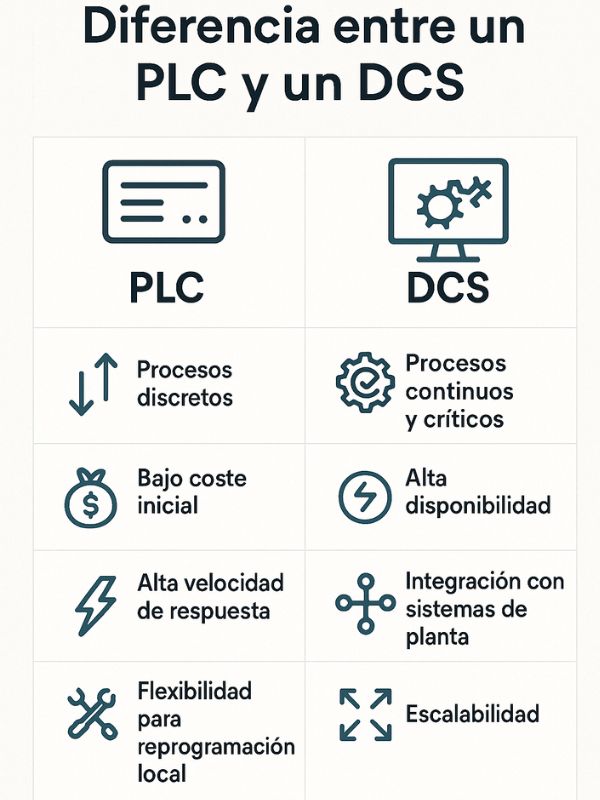
When evaluating which system to implement, it is essential to analyze not only the benefits of each solution but also their potential restrictions. Both PLC and DCS have strengths that make them ideal for certain applications, as well as limitations that can influence the decision depending on the industrial context. This table clearly summarizes the key aspects of both.
When evaluating which system to implement, it is essential to analyze not only the benefits of each solution but also their potential restrictions. Both PLC and DCS have strengths that make them ideal for certain applications, as well as limitations that can influence the decision depending on the industrial context. This table clearly summarizes the key aspects of both.
Summary Table of Advantages and Limitations:
| Category | Key Aspects | PLC | DCS |
|---|---|---|---|
| Strengths | Cost and Installation | Low initial cost and easy installation | High availability due to integrated redundancy |
| Response Speed | High response speed | Advanced process control (PID, cascade, etc.) | |
| Flexibility and Control | Flexibility for local reprogramming | Total integration with plant systems | |
| Scalability | Ideal for discrete processes | Scalability without architectural redesign | |
| Limitations | System Complexity | Does not manage large systems well without external SCADA | Requires greater investment and qualified personnel |
| Change Management | — | Minor changes require online (hot) planning |
Technical and Strategic Criteria for Deciding Between PLC and DCS
Choosing between a PLC or a DCS is not just a matter of technology, but of deeply understanding the operational and growth needs of the plant.
Process Type: Discrete vs. Continuous
Sequential and discrete processes (assembly, robotics, filling) favor the use of PLCs. Continuous and critical processes (refinery, energy, water) are the domain of the DCS.
Signal Volume and System Complexity
Fewer than 500 signals are usually well managed by a PLC. When exceeding 1,000 I/O, the DCS becomes more efficient.
Security, Redundancy, and European Regulatory Requirements
The DCS better complies with regulated environments (pharmaceutical, energy), where traceability, redundancy, and centralized control are essential.
Available Personnel and Learning Curve
The PLC is more accessible for technicians with basic training. The DCS requires more advanced technical profiles but reduces the operational load once implemented.
Compatibility with Existing Systems
Both can integrate with SCADA, MES, or ERP, but the DCS does so natively and more efficiently.
Future Projection: Expansions and New Technologies
If growth or integration with technologies such as IoT or predictive maintenance is anticipated, the DCS offers a more robust and scalable foundation.
Use Cases and Real Situations: PLC vs. DCS, Which to Choose?
Understanding the theory is important, but seeing how these systems are applied in real contexts provides a decisive perspective. Below, we explore concrete examples where a PLC, a DCS, or a combination of both offer effective solutions according to the needs of each industrial environment.
Typical PLC Application: Automated Cell in Bottling
Each station has its own PLC to control sensors, valves, and conveyor belts, allowing for quick changes and local adjustments.
DCS Case: Chemical Plant with Complex Continuous Processes
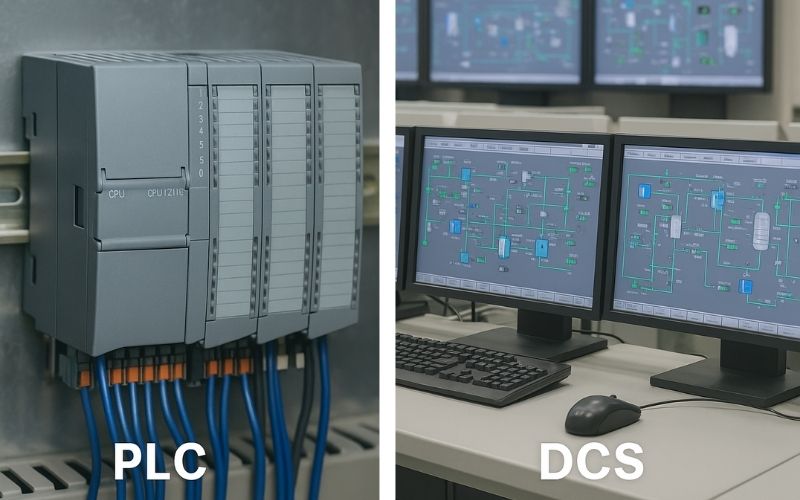
A centralized control room monitors temperature, pressure, flow rates, and alarms from multiple process units with the necessary redundancy.
Mixed Example: Hybrid PLC+DCS System with Distributed Control
In modern plants, it is common to see PLCs controlling discrete subsystems and a DCS supervising the entire system from a single interface.
Current Trends in Industrial Automation
Industrial automation is rapidly evolving towards more connected, secure, and predictive environments. These trends reflect how PLCs and DCS are adapting to offer greater integration, operational intelligence, and preparedness for future challenges.
Convergence of Technologies: PAC, Edge Computing, IoT
PLCs are evolving towards PACs (PC-based controllers) with distributed computing capabilities. The DCS incorporates interoperability with emerging technologies.
Open DCS and PLCs with Distributed Functions
The trend is for both to converge: PLCs with IoT connectivity and DCS with standard protocols like OPC UA, integrating easily with other systems.
Predictive Maintenance and Real-time Analytics
The DCS facilitates the analysis of historical data and real-time events. Modern PLCs are also beginning to integrate with analytics platforms.
Cybersecurity in Critical Plant Environments
The DCS usually includes cybersecurity layers by default. For PLCs, it must be added according to the design, being more vulnerable if not implemented correctly.
How BAMA Sistemas Can Help You Choose and Scale Your Control System
Having a trusted technical partner can make the difference between implementing a functional system and one truly optimized for your plant. At BAMA Sistemas, we support our clients from the analysis phase to continuous support, guaranteeing scalable automation solutions that are secure and adapted to each industrial environment.
- Specialized Technical Consulting: We help you identify the most suitable system for your process, whether discrete, continuous, or hybrid.
- Custom Architecture Design: We develop efficient solutions based on PLC, DCS, or combinations according to your facility’s needs.
- Integration, Maintenance, and Continuous Improvement Services: From commissioning to operational optimization, we provide comprehensive coverage across Europe.
- Proven Experience in Multiple Sectors: We have successful projects in industries such as food, energy, water treatment, and pharma, for both SMEs and large corporations. We have a proven track record of satisfied clients in sectors such as food, energy, pharmaceutical, and water treatment.
Quick Comparison for Decision Making
Key Questions Checklist:
- Is it a discrete or continuous process?
- What is the total volume of signals?
- Is high availability or fault tolerance required?
- What level of integration with other systems is needed?
- What is the available budget and expansion plan?
Summary Comparison Table:
| Feature | PLC | DCS |
| Process type | Discrete | Continuous |
| Scalability | Limited | High |
| Redundancy | Optional | Built-in |
| Scan Time | 1-10 ms | 100-500 ms |
| Initial cost | Low | High |
| Programming Ease | High | Medium |
| Integration with SCADA/MES | External | Native |
| Ideal for… | Individual machines | Entire plants |
Optimize your plant’s control and efficiency with custom-designed PLC, DCS, or hybrid systems.
Low-Medium