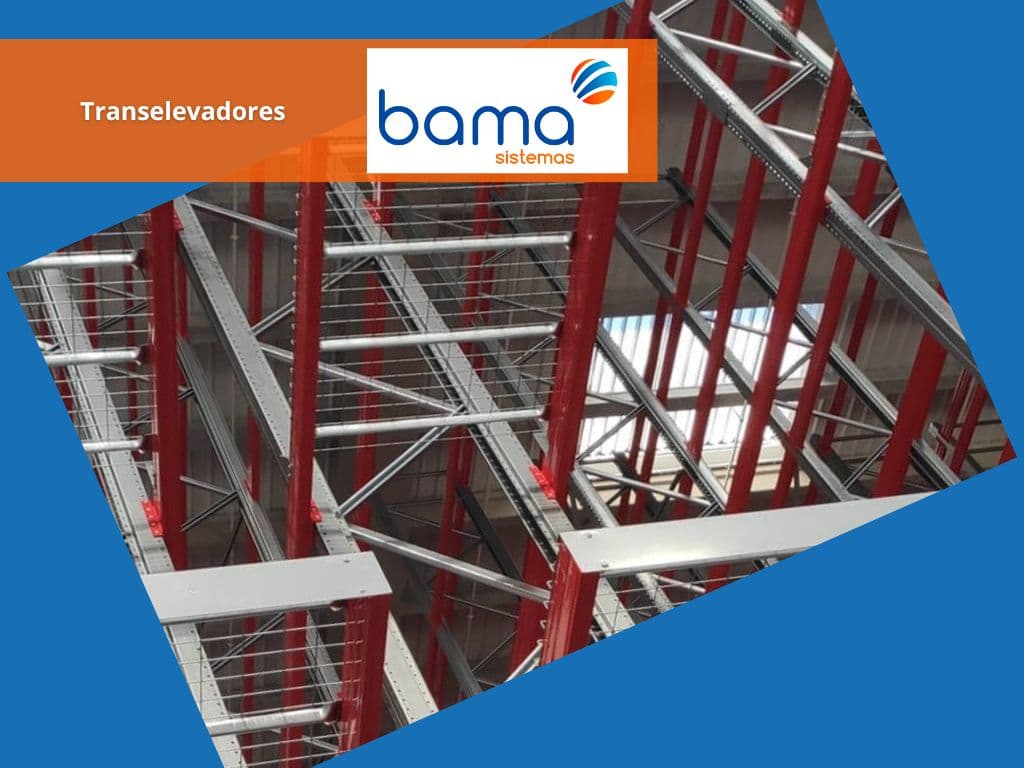
Below, we are going to explain what stacker cranes are first-hand. At BAMA, we are dedicated to process automation and have authentic experts in warehouse automation who wanted to share their knowledge on the subject with you.
What is a stacker crane?
A stacker crane is an electro-mechanical system capable of moving loads in dynamic racking aisles, allowing for warehouse optimization by taking advantage of its height.
Stacker cranes perform two types of movement: longitudinal and in height.
They consist of a series of lifting chains, drag cables, rails, and electric motors for moving goods between the racks. They feature a platform or cradle with a system responsible for extracting or depositing the goods in said racks.
Stacker cranes are characterized by their high-speed travel. This makes them ideal for automated warehouses that require a high volume of load movement.
Main components of a stacker crane
Stacker cranes are composed of several key elements that guarantee their efficient operation:
- Support structure: Includes rails and columns that guide the movement of the stacker crane.
- Electric motor: Provides the necessary power for longitudinal and lifting movements.
- Platform or cradle: The part that holds and transports the load, whether it is a pallet, a box, or another type of merchandise.
- Control system: Manages movements and coordination with other warehouse systems.
- Safety sensors: Detect obstacles and ensure safe operation.
How a stacker crane works
The operation of a stacker crane is based on the combination of longitudinal movements (along the aisle) and vertical movements (in height).
- Longitudinal movement: The stacker crane moves on rails along the aisle to position itself in front of the desired rack.
- Vertical movement: Once in the correct position, the lifting system raises or lowers the platform to reach the rack level.
- Extraction or deposit: The platform uses a mechanism to extract or deposit the load in the rack.
This process is repeated quickly and precisely, optimizing time and space in the warehouse.
Applications of stacker cranes
Although it is common to find stacker cranes in automated warehouses within distribution industries, at BAMA we have specialized in stacker cranes with specific applications for industries such as aeronautics, automotive, or pharmaceuticals, among others.
In these cases, the racks are specially designed for bulky, heavy, and/or delicate products, and conducting a thorough preliminary study can make the difference between fluid operations and a chain of constant problems.
Nevertheless, in general terms, stacker cranes are typically used in different circumstances:
Use in automated warehouses
Stacker cranes are fundamental in automated warehouses, where fast and efficient handling of large volumes of goods is required. Their ability to operate at high heights and in narrow aisles makes them the ideal choice for maximizing available space and reducing operation times.
Applications in the logistics industry
In the logistics industry, stacker cranes are used to optimize the flow of goods, from product reception to dispatch. Their integration with Warehouse Management Systems (WMS) allows for perfect coordination between the different stages of the logistics process, improving productivity and reducing errors.
Types of stacker cranes
- Unit Load Stacker Cranes: These are used for handling unit loads and are ideal for warehouses with a high level of product turnover.
- Pallet Stacker Cranes: These are designed for the storage and retrieval of pallets. They are used in warehouses that require high storage capacity.
- Miniload Stacker Cranes: These are used for handling small loads, such as boxes or container-type trays. They are ideal for warehouses that require high precision in load handling.
- Trilateral Stacker Cranes: These can move in three directions and are ideal for warehouses with narrow aisles.
Advantages of a storage system with a stacker crane
A warehouse with a stacker crane system offers the following advantages:
- Scalability: They can grow with the company’s needs. By expanding the racking, either in height or longitudinally, the warehouse adapts to every circumstance.
- Safety: They feature a secure system that prevents personnel from circulating along the stacker crane’s path.
- Agility: It is a very fast system, which helps reduce logistics costs in the plant. It is also capable of grouping loads, both for retrieval from the racks and for depositing them.
- Flexibility: It can work with dynamic racking systems, helping to optimize the warehouse.
- Space and time savings: Stacker cranes allow for maximum utilization of the warehouse’s vertical space, reducing the need for physical expansions. Additionally, their operating speed minimizes loading and unloading times, resulting in greater operational efficiency.
- Reduction of operating costs: By automating storage and retrieval processes, stacker cranes reduce reliance on labor and minimize human error. This translates into a significant decrease in long-term operating costs.
Discover the fascinating world of stacker cranes! Immerse yourself in knowledge and explore what a stacker crane is, how it works, and how it can revolutionize your storage operations. Don’t wait any longer! Embark on this exciting learning journey now.
Frequently asked questions about stacker cranes in warehouses
What should be considered before installing a stacker crane system in an existing warehouse?
Before installing a stacker crane system in an operational warehouse, it is fundamental to analyze the rack structure, available height, flow of goods, and compatibility with current systems. A preliminary technical study helps avoid unforeseen costs and ensures effective integration.
Is it possible to use stacker cranes in refrigerated or temperature-controlled warehouses?
Yes, stacker cranes can be adapted to operate in refrigerated environments or with special temperatures, as occurs in sectors such as food or pharmaceuticals. In these cases, specific materials and components are used that withstand the required thermal conditions.
How much space can be optimized in a warehouse with the implementation of stacker cranes?
By implementing stacker cranes, vertical space can be maximized and aisle width reduced. This allows for an increase in storage capacity without the need to expand physical facilities.
What level of integration does a stacker crane require with Warehouse Management Software (WMS)?
To function efficiently, the stacker crane must be correctly integrated with the company’s WMS or ERP. This connection allows for automated storage, precise location of goods, and management of movements without manual intervention.
What are the most common errors when implementing stacker cranes and how can they be avoided?
Among the most common errors are oversizing the system, not properly analyzing the logistics flow, or not foreseeing integration with existing systems. These failures can be avoided with proper planning and a specialized technical study.
When is it advisable to opt for a stacker crane retrofit instead of replacing them completely?
Retrofitting is a recommended option when the general structure of the system remains valid, but some components are obsolete or exhibit recurring failures. It is an effective way to modernize the system with a more contained investment.