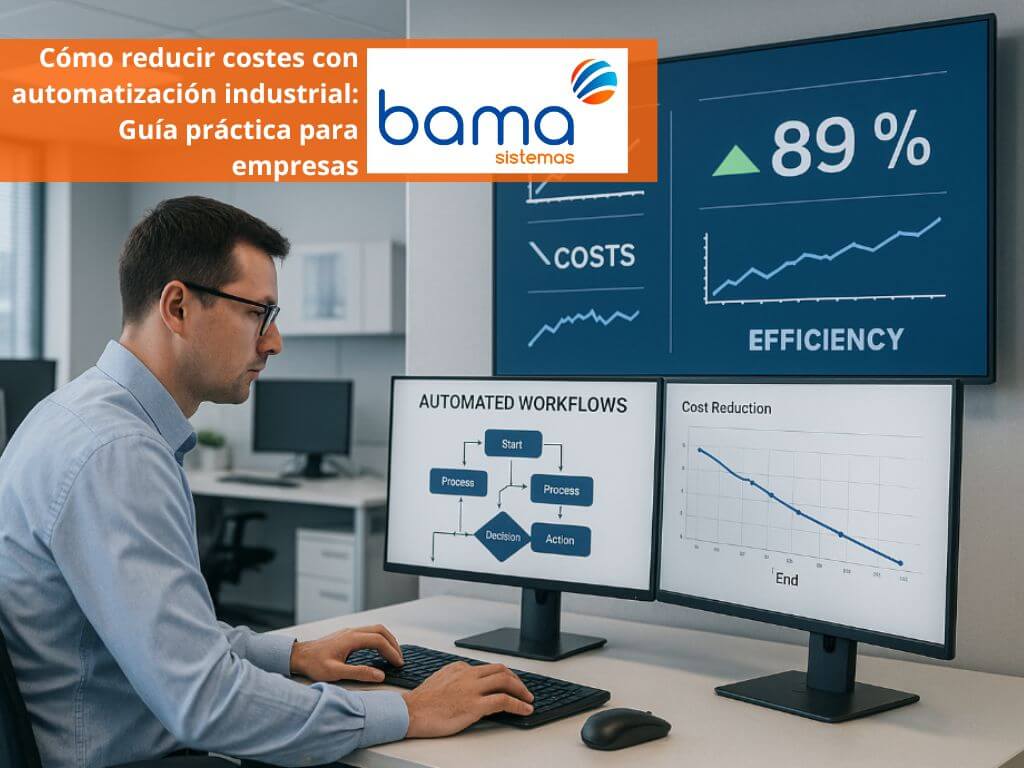
The reduction of costs through industrial automation has become a priority for companies seeking to maintain competitiveness without compromising efficiency. In a scenario marked by cost pressure and the need to respond agilely to the market, industrial automation ceases to be merely a technological option and becomes a key operational optimization strategy.
From Bama Sistemas, we guide you in this article through the best practices, application areas, and concrete steps to implement automation solutions that allow you to minimize costs without losing productivity.
Industrial Automation: A Key Strategy for Cost Reduction
Automation allows for rethinking operational efficiency. Beyond the initial investment, its impact translates into tangible savings in the medium and long term, thanks to:
- Elimination of repetitive tasks.
- Reduction of production times.
- Reduced need for manual supervision.
- Continuous improvement based on data.
These combined factors drive a more agile and profitable operational structure.
Areas Where Automation Enables Cost Reduction
Below, we analyze the environments where automation not only improves efficiency but also allows for significant savings through resource optimization, error reduction, and the acceleration of critical tasks. Identifying these areas is the first step to designing an effective automation strategy tailored to the needs of your plant or production line.
Production and Assembly
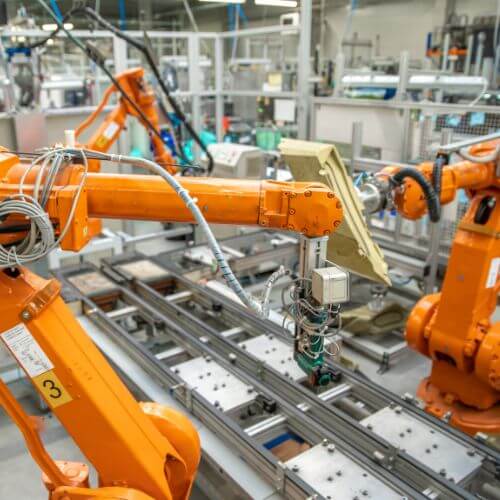
Automated production lines reduce costs in:
- Man-hours: by decreasing manual intervention.
- Material waste: thanks to the precision of automated systems.
- Cycle times: producing more in less time.

Collaborative robots
In environments requiring repetitiveness, collaborative robots (cobots) allow working alongside human personnel, taking on tasks such as welding, screwing, assembly, or handling, reducing risks and operational costs.
Quality Control Automation
Automating visual and dimensional inspection allows for real-time defect detection and avoids costly rework.

Machine Vision Systems
Using cameras and advanced algorithms, these systems analyze each product and eliminate unwanted variations, improving consistency and reducing waste.

Internal Logistics and Warehouse Management
Automating logistics and material handling can directly impact operating expenses.

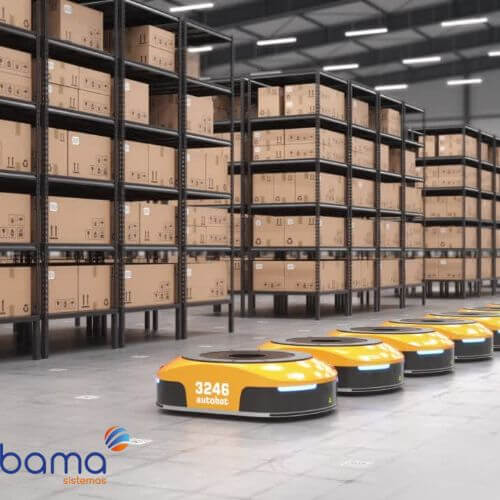
AGV Systems and Automated Warehouses
- Automated Guided Vehicles (AGVs) transport materials without the need for operators.
- Automated warehouses reduce physical space and search time, optimizing resources.
How to Approach Automation for Cost Reduction: A Step-by-Step Process
Automating without planning can be counterproductive. Here’s how to do it correctly:
1. Analyze your current processes
Before investing in automation, it is essential to perform a process diagnosis:
- Where do bottlenecks occur?
- Which tasks consume the most resources?
- Which processes present the most errors or reworks?
This analysis will allow you to identify areas with the greatest potential for savings.
2. Calculate the ROI of automation
The Return on Investment (ROI) must be clear from the outset. To do this, consider:
- Implementation cost.
- Current operating costs vs. costs after automation.
- Projected savings in personnel, materials, and time.
Estimated payback period.
3. Select the appropriate solution
Not all technologies are applicable to all cases. Therefore, it is key to:
- Study technological alternatives with technical and economic criteria.
- Evaluate compatibility with existing systems (ERP, MES, sensors, etc.).
- Work with an integrator like Bama Sistemas to advise you throughout the process.
4. Progressive and controlled deployment
It is recommended to first implement a pilot project or minimum viable product in a critical area. This allows for:
- System testing.
- Making adjustments.
- Measuring results.
- Planning for scaling.
5. Measure and adjust constantly
Automation is not static. It is necessary to measure KPIs such as:
- Defect rate.
- Process times.
- Costs per unit produced.
With this data, parameters are adjusted, and new opportunities for improvement are detected.
Automation and Business Culture: A Necessary Change
Automating is not just a technological matter; it also implies a cultural transformation. Companies that best implement automation:
- Train their personnel in new skills.
- Reassign tasks instead of eliminating positions.
- Promote continuous improvement.
In this sense, automation should be seen as an ally of people, not a threat.
Industrial automation is a strategic lever to reduce costs and improve your company’s profitability. From production lines to administrative processes, there are concrete solutions that allow you to do more with less.
At Bama Sistemas, we have been supporting industrial companies on this journey for years. If you are evaluating automation as an optimization tool, contact us without obligation and we will help you design a solution tailored to your needs.
We hope you found this article of interest.
Reduce operational costs with industrial automation solutions: optimize your processes, eliminate inefficiencies, and improve your company’s profitability.