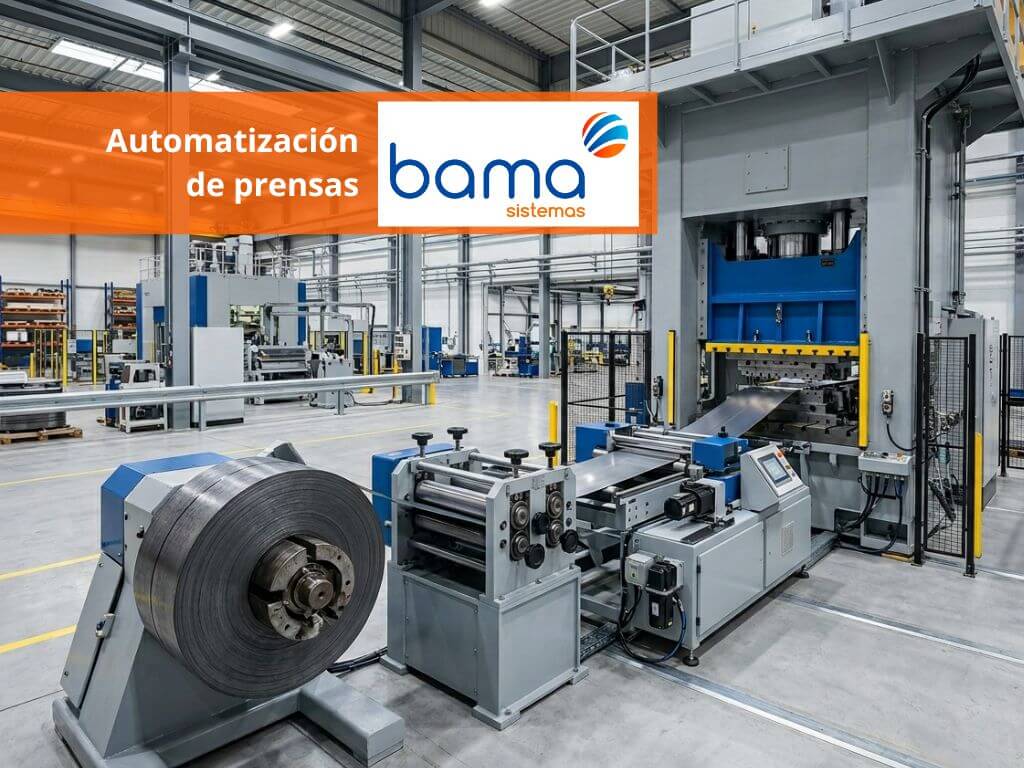
How many parts per minute do you lose because your press waits for material to arrive? In most plants, the bottleneck isn’t the press itself, but how it’s fed. Press automation solves exactly that: ensuring material reaches the die with the speed, precision, and consistency that production demands.
Here you will find what it means to automate your press line, which technologies apply to your case, and how to implement a turnkey project without improvisation.
Why should you automate your press feeding?
In a press line with manual loading, the actual speed is not set by the press but by the operator. It doesn’t matter if your press can handle 25 strokes per minute if the material arrives at 6 because someone has to position each sheet, move away from the risk zone, and give the cycle command. This gap between real capacity and effective production results in consequences that accumulate shift after shift:
- Limited speed: the line’s speed depends on human pace, not the machine’s potential
- Scrap due to misalignment: each manual load introduces variability that generates defective parts or die failures
- Risk of accident: presses are among the machines with the highest accident rates in industrial environments
- Loss of competitiveness: plants that have already automated offer shorter lead times, lower unit costs, and defect rates that a manual line cannot match
The problem isn’t that your press is insufficient. The problem is that the way it receives material prevents it from producing at its real capacity. And until that changes, the gap with your competitors widens with each shift.
Components of a Press Automation System
Automating a press is not just about installing a feeder and connecting it. A complete press automation system integrates several subsystems that must work in sync with each other and with the press for the line to operate with the speed, precision, and safety that production demands. If one fails, everything fails.
These are the components involved in a complete system:
Automatic Press Feeding System
This is the set of equipment that delivers material to the die under the correct conditions. In coil lines, it includes three elements: the uncoiler that releases the coil, the straightener that corrects curvature so the material enters flat, and the feeder that advances the strip with the exact length at each stroke. In cut sheet lines, it is replaced by destackers and automatic loading systems.
Control and Synchronization with the Press
The feeder does not work independently. Each material advance must be electronically synchronized with the press angle using encoders that communicate the ram’s position in real time. A millisecond delay means a defective part or an impact against the die that stops the line for hours.
Integration with PLC, SCADA, and MES
The PLC manages the logic of the entire cycle: feeding sequence, safety signals, alarms, and production parameters. A complete system also connects with SCADA for real-time monitoring and with the plant’s MES for traceability and OEE calculation. Without this integration, you automate the stroke but not the process.
Safety Guards and End-of-Line
Manually inspecting thousands of parts per shift generates fatigue, inconsistency, and defective parts that advance down the line. Automated quality control detects deviations in real time, before the error multiplies at subsequent stations.
Types of Automated Feeders for Industrial Presses
There is no universal feeder. The type of system your line needs depends on specific variables: the material you process, the strip thickness, the target speed, the available space, and whether you work with coil or cut sheet. Choosing the wrong feeder means investing in a solution that limits the line instead of enhancing it.
Pneumatic and Mechanical Roller Feeders
These are the most economical and most limited option. Pneumatic feeders advance material using air-actuated grippers with speeds rarely exceeding 80 strokes per minute. Mechanical roller feeders operate by friction with opposing rollers actuated intermittently. Both are suitable for short runs, simple parts, and tight budgets where feeding precision is not critical.
High-Speed NC Servo Feeders
The current standard in demanding production lines. A servomotor controls material advance with hundredths of a millimeter precision, electronically synchronized with the press angle. They allow speeds exceeding 30 strokes per minute, parameter changes without stopping the line, and NC programming for different references. They are the option when the part requires tight tolerances or when you need flexibility to change production quickly.
3-in-1 Compact Systems: Uncoiler, Straightener, and Feeder
They integrate all three functions into a single compact unit. They reduce floor space, simplify installation, and shorten coil changeover times by eliminating connections between independent machines. They are the most efficient solution when space is limited or when a new line is being set up from scratch and the goal is to minimize the plant footprint.
Transfer Systems Between Presses for Tandem Lines
When a part requires several stamping operations in consecutive presses, the material must move from die to die automatically. Transfer systems solve this with crossbars, robots, or programmable feeders that transfer the part between synchronized presses. This is the usual configuration in automotive plants for body panels and large structural parts.
| Type | Speed | Accuracy | Investment | Typical application |
|---|---|---|---|---|
| Pneumatic / Mechanical | Low (up to 80 spm) | Medium | Low | Short runs, simple parts |
| NC Servo Feeder | High (30+ spm synchronized) | Very high | Medium-high | Demanding runs, frequent changes |
| 3-in-1 System | Medium-high | High | Medium | New lines, limited space |
| Press Transfer | Variable depending on configuration | High | High | Progressive stamping, automotive |
How to automate already installed presses without replacing the entire line
Many plants don’t start from scratch. They have presses that are mechanically sound but whose feeding system is manual, semi-automatic, or based on technology that no longer provides the speed or precision that current production demands. The good news is that in most cases, there’s no need to replace the press: what’s needed is to modernize what surrounds it.
Retrofit of the Feeding System in Existing Presses
Replacing an old pneumatic feeder with an NC servo feeder on the same press can multiply the actual line speed without touching the main machine. The retrofit of industrial presses includes sizing the new feeding system according to the press characteristics (tonnage, stroke, cycle speed), mechanical adaptation to the existing bed, and integration with the machine’s control. It is a faster, more economical intervention with less production downtime than a complete greenfield implementation.
Migration of Obsolete Controls to Current PLC
Many presses from the 90s and 2000s operate with relay-based controls or discontinued PLCs with no available spare parts. Migrating to a current PLC allows reprogramming the entire cycle logic, incorporating real-time fault diagnostics, and connecting the press with the plant’s SCADA and MES. The press remains the same; its control and monitoring capabilities become those of a new machine.
Updating Safety Guards to Current Standards
An old press modernized with a new feeding system is considered a substantial modification of the machine. This requires re-evaluating the complete safety system and adapting it to current regulations: photoelectric barriers, optical curtains, safety logic integrated into the PLC, and perimeter fencing. Failure to do so exposes the facility owner to legal liability in the event of any incident.
How a Turnkey Press Automation Project is Executed
Automating a press line is not about buying equipment and assembling it. It is an engineering project with defined phases where each technical decision influences the next. Knowing the process beforehand allows you to plan resources, anticipate necessary downtimes, and clearly understand what to expect at each stage.
Process Analysis and Requirements Definition
Everything starts at your plant. The current pressing process is studied: what material is processed, what parts are produced, at what speed, with what limitations, and what improvement objective is sought. This analysis yields the project’s technical requirements: type of feeding needed, target speed, level of integration with existing systems, and space or production constraints that affect implementation.
Design, Manufacturing, and On-Site Integration
With the requirements defined, the complete solution is designed: mechanical, electrical, electronic, and control. Equipment is selected or manufactured, the PLC is programmed with the line’s specific cycle logic, and installation is planned to minimize production downtime. On-site integration includes connection to the existing press, feeder synchronization, and communication with SCADA and MES if the plant requires it.
CE Marking, Commissioning, and Maintenance Plan
Before starting production, the installation must pass conformity assessment and obtain CE marking. This includes risk analysis, verification of safety guards, and complete technical documentation. Once this step is completed, commissioning is carried out with adjustments in real production until the target speed and quality are achieved. The project does not end there: it is delivered with a preventive maintenance plan for the feeding system to ensure long-term line performance.
A well-executed turnkey automation project covers this entire cycle under a single responsible party. No coordination between multiple suppliers, no gray areas between phases, and no stage left outside the project’s scope.
Why BAMA is the Partner to Automate Your Press Line
For industrial plants that need to automate or modernize their press lines, having an engineering partner capable of undertaking the complete project is crucial.
BAMA Sistemas designs, manufactures, integrates, and maintains press automation systems with a turnkey approach that covers everything from initial process analysis to maintenance of the installed system in production.
Originating in the automotive sector since 1997 and with almost three decades of experience in high-demand environments, BAMA integrates feeding systems, press control, PLC programming, connection with SCADA and MES, and CE certification into a single project without reliance on third parties.
Do you need to automate or modernize your press feeding?
Low-Medium