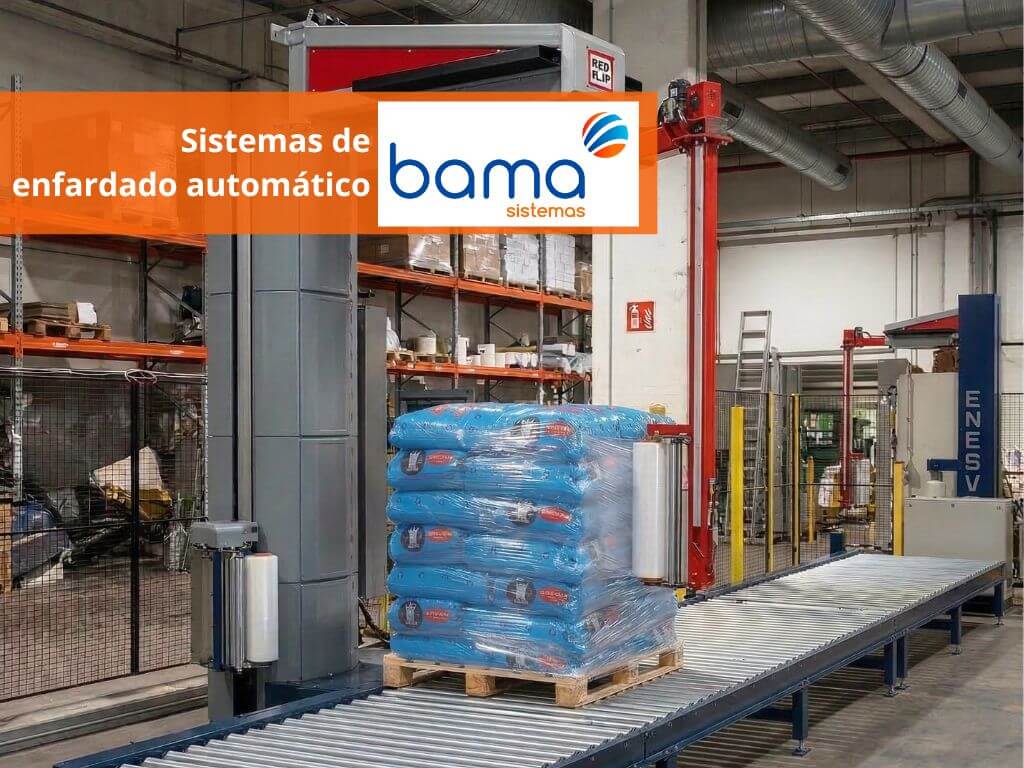
Every pallet leaving your plant without proper securing is a latent risk: dock rejections, customer returns, and direct margin loss. This is where automatic pallet wrapping systems cease to be auxiliary machinery and become the backbone of resilient and competitive logistics.
In sectors with high production volumes, automating pallet wrapping reduces operational costs, improves packaging consistency, and increases overall plant productivity.
What are Automatic Pallet Wrapping Systems?
An automatic pallet wrapping system is a set of electromechanical and control equipment designed to wrap pallets or unit loads with stretch film in a fully automated manner. Its main objective is to generate the necessary containment force to stabilize the load during storage and transport, acting as the last line of defense against moisture, dust, and load shifts.
Function of Pallet Wrapping in Industrial Logistics
Pallet wrapping fulfills several key functions within the logistics chain:
- Maintain the structural integrity of the pallet
- Protect goods from dust, moisture, or contamination
- Prevent shifts during transport
- Facilitate handling and storage
An automated system ensures that these functions are always performed with the same film tension and overlap parameters, eliminating the variability of the manual process.
Why the Pallet Wrapper is Key in End-of-Line Operations
Pallet wrappers are located at the last point of the production process before dispatch. Therefore, they act as the final safety barrier that ensures goods arrive at the customer in optimal condition.
Poor load stabilization can lead to:
- Damage during transport.
- Customer claims.
- Economic losses.
- Logistics security issues.
For this reason, many companies are incorporating automatic pallet wrapper solutions into their industrial automation strategies.
How an Automatic Pallet Wrapper Works
Automatic pallet wrappers operate through a PLC-controlled cycle that manages each stage of the wrapping process.
Automatic Pallet Wrapping Operating Cycle
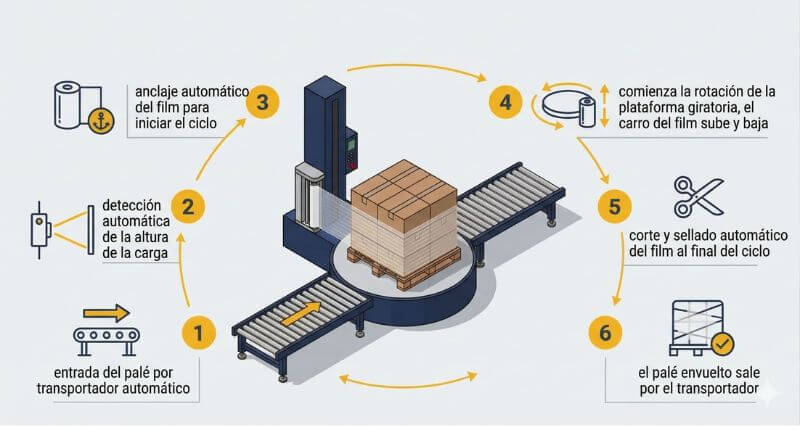
The standard process usually includes the following phases:
- Pallet entry into the wrapping station via automatic conveyors.
- Load height detection using sensors or photocells.
- Initial film anchoring to start the cycle.
- Pallet wrapping by platform rotation or wrapping system.
- Film cutting and sealing at the end of the cycle.
This process allows for absolute repeatability, guaranteeing the same wrapping quality for each pallet.
Key Components of an Industrial Pallet Wrapper
An automatic pallet wrapper integrates different mechanical and electronic systems that ensure its operation:
- Pallet transport system
- Film carriage with motorized pre-stretch
- Control PLC
- Height and position sensors
- Automatic cutting and sealing system
In advanced industrial lines, these systems can be integrated with plant control systems to automatically manage wrapping recipes according to product type.
Types of Automatic Industrial Pallet Wrapping Systems
Not all pallet wrappers operate the same way. The system architecture must be selected based on load stability, production volume, and the required level of automation.
Turntable Pallet Wrappers
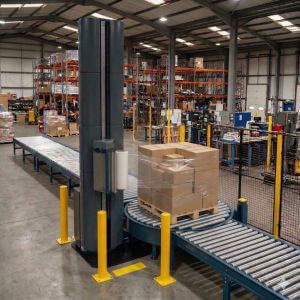
These are one of the most widespread systems in industrial facilities. The pallet is placed on a platform that rotates while the film carriage moves up and down, wrapping the load.
This system is typically used in medium-volume productions where a robust and reliable solution is sought.
Rotary Arm Pallet Wrappers
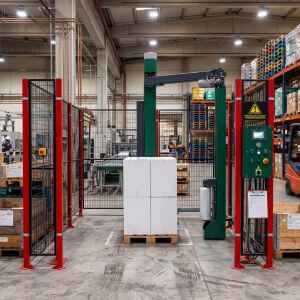
In this system, the load remains static while the arm carrying the film rotates around the pallet.
This design is particularly suitable for:
- unstable loads
- very light products
- very heavy pallets
By avoiding load rotation, the risk of pallet mosaic collapse is reduced.
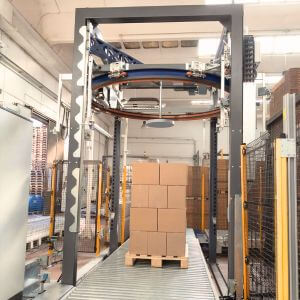
Rotary Ring Pallet Wrappers
Rotary ring systems are designed for high-speed production lines.
The ring rotates around the pallet as it moves up or down, allowing for very fast wrapping cycles with high precision in film tension control.
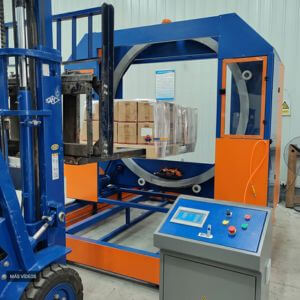
Orbital Pallet Wrappers for Long Products
This type of machine is mainly used in sectors such as construction, metallurgy, or the aluminum industry.
They allow longitudinal products such as profiles, tubes, or panels to be wrapped using a horizontal ring system.
Benefits of Automating Pallet Wrapping in End-of-Line Operations
Automating pallet wrapping offers clear advantages at both operational and economic levels.
Increased Productivity
An automated line can wrap dozens of pallets per hour with minimal operator intervention, significantly increasing the production capacity of the end-of-line.
Film Savings and Cost Reduction
Motorized pre-stretch carriages allow the film to be stretched before being applied to the load, reducing material consumption and optimizing the cost per pallet.
Load Stability and Security
Precise control of film tension ensures constant containment force, which improves pallet stability during transport.
This reduces the risk of damage and improves safety in logistics handling.
Integration of Automatic Pallet Wrappers into Production Lines
One of the great benefits of modern pallet wrapping systems is their ability to integrate within the end-of-line ecosystem.
Synchronization with Palletizers
Automatic pallet wrappers usually work in conjunction with robotic or conventional palletizers, forming part of a fully automated line.
Integration with MES and ERP Systems
The most advanced solutions allow connection with plant management systems to automatically receive wrapping parameters according to product or order type.
Industrial Control and Traceability
Integration with monitoring systems allows for recording production data, consumption, and wrapping cycles, improving traceability and operational control.
Pallet Wrapping Automation: The Key to an Efficient End-of-Line
The incorporation of Automatic Pallet Wrapping Systems transforms the end-of-line into a safer, more efficient, and fully integrated process within the production chain.
Specialized companies like BAMA develop end-of-line optimization solutions with pallet wrappers capable of adapting to different industrial sectors and production levels.
Do you want to know which pallet wrapping system best suits your production?
Low-Medium