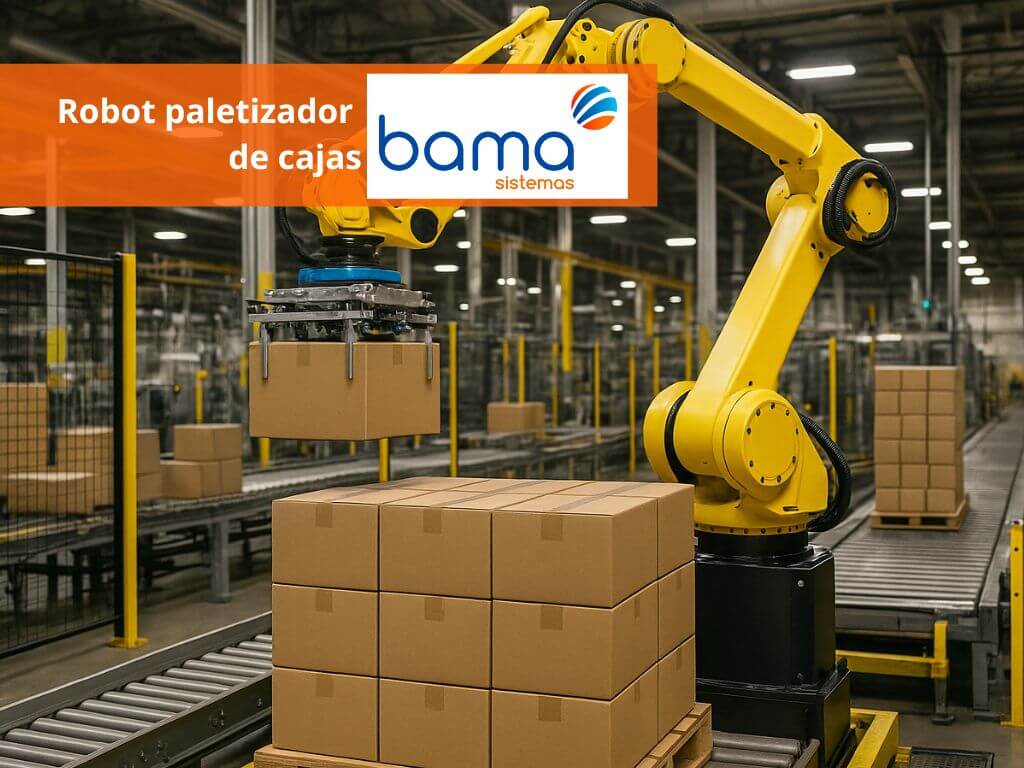
At the end of line of any production industry, there is a critical point that marks the difference between efficiency and bottleneck: palletizing. More and more factories rely on automated solutions such as the box palletizing robot, capable of streamlining that key phase and reducing time and errors to a minimum. However, not all systems work the same way or offer the same advantages. What options exist and how do you know which one truly fits your industry?
What is a Box Palletizing Robot?
A palletizing robot is an automatic system that picks products from a production line and organizes them on a pallet following a predefined pattern. Unlike manual palletizing, these robots ensure repeatability, reduce errors, and increase productivity.
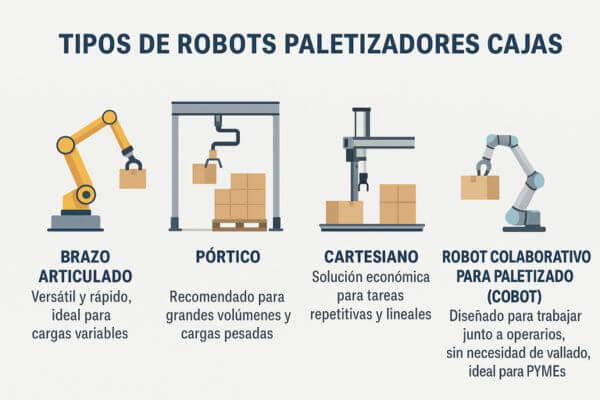
Types: Articulated Arm, Gantry, Cartesian, Collaborative (Cobot)
There are different types of palletizing robots, and each responds to specific needs depending on the production environment, type of load, and desired degree of automation. Choosing the right model is key to obtaining the best performance and return on investment.
- Articulated arm: versatile and fast, ideal for variable loads.
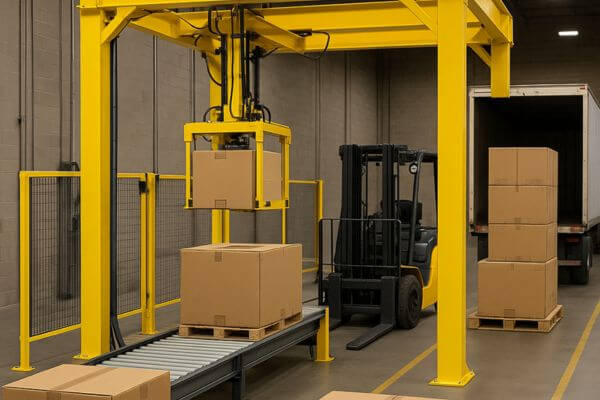
- Gantry: recommended for large volumes and heavy loads.
- Cartesian: economical solution for repetitive and linear tasks.
- Collaborative palletizing robot (cobot): designed to work alongside operators, without the need for fencing, ideal for SMEs.
Advantages Over Conventional Systems
The incorporation of a palletizing robot compared to traditional manual or mechanical palletizing offers multiple benefits that directly impact productivity and operational safety.
- Greater safety and ergonomics.
- Reduction of operating costs.
- Increased palletizing speed.
- Scalability and adaptability to production changes.
Types and Selection Criteria for a Palletizing Robot
Choosing the right robot depends on the specific needs of each industry. Factors such as the nature of the product, production rate, available space, and budget determine which type of palletizing robot is most effective for each case. Below are the most relevant technical aspects that should be evaluated before making a decision.
Capacity and Operating Speed
Palletizing robots can reach up to 1,200 cycles per hour depending on the model and line configuration. This speed is crucial in industries with high demand. As for load capacity, collaborative models (cobots) are designed for light loads (10-20 kg), while industrial gantry robots can handle more than 500 kg per cycle, making them ideal for heavy products or bulky packaging.
Space, Installation, and Adaptability
The configuration of available space at the end of line is a determining factor. Articulated arms offer great performance in reduced spaces thanks to their compact design and versatile range of motion. Cartesian and gantry systems, on the other hand, require larger dimensions and fixed structures, but provide robustness and precision in demanding environments. Likewise, ease of integration with existing lines improves the overall adaptability of the system.
Costs, Maintenance, and Expected Lifespan
The initial cost of a palletizing robot varies depending on type, brand, and level of automation. However, the investment is offset by an average lifespan of between 10 and 15 years, provided that proper preventive maintenance is performed. This includes lubrication of axes, inspection of electrical components, and updating of control software. Periodic maintenance minimizes failures, reduces unplanned downtime, and ensures a sustainable return on investment in the medium term.
Operation and Configuration of Palletizing Robots
These systems operate through programmable controllers (PLC) and specialized software.
Pattern Programming
Allows configuration of different stacking patterns according to box or pallet type, optimizing space and load stability.
Integration with Existing Lines and Peripherals
The robot can coordinate with conveyors, vision systems, labelers, and other solutions already installed.
Turnkey Solutions and Professional Installation with BAMA
At Bama Sistema, we offer industrial automation solutions with palletizing robots adapted to each client.
Customized Technical Assessment
We evaluate your production line to select the system that best adapts to your operational flow.
Implementation and Commissioning
Our technicians install and calibrate the system ensuring a smooth transition without interruptions in production.
Training, Support, and Post-Implementation Maintenance
We provide training for your operators, continuous support, and preventive maintenance to ensure maximum system efficiency.
Technical Comparison of Palletizing Robots
Before choosing a palletizing system, it is essential to objectively compare the technical capabilities of each type of robot. This table summarizes key aspects such as speed, maximum load, fencing requirements, and estimated cost, allowing quick identification of which solution best adapts to each company’s production needs, space, and budget.
| Robot Type | Speed (boxes/hour) | Maximum Load | Requires Fencing | Relative Cost |
|---|---|---|---|---|
| Articulated arm | Up to 1,200 | 50-200 kg | Up to 600 | Yes |
| Medium-High | Gantry | Up to 900 | Up to 600 | High |
| Yes | High | Cartesian | Up to 600 | 50-100 kg |
| Yes | Medium | Cobot | Up to 300 | 10-20 kg |
Do you need a robotic case palletizer?
Low-Medium
contact now
Frequently Asked Questions About Palletizing Robots
Can a palletizing robot adapt to different box sizes?
Yes, through sensors and flexible programming, it can adjust to different formats.
How long does it take to install a palletizing robot?
Depending on complexity, between 1 and 3 weeks including testing and training.
Is it necessary to train operators to use it?
Yes, although the interfaces are intuitive, Bama.es offers complete training.
Can it be integrated with existing systems?
What maintenance does it require?
It requires periodic preventive maintenance: lubrication, sensor inspection, and software updates.
What is the estimated ROI?
On average, between 12 and 24 months, depending on work volume and replacement of manual labor.