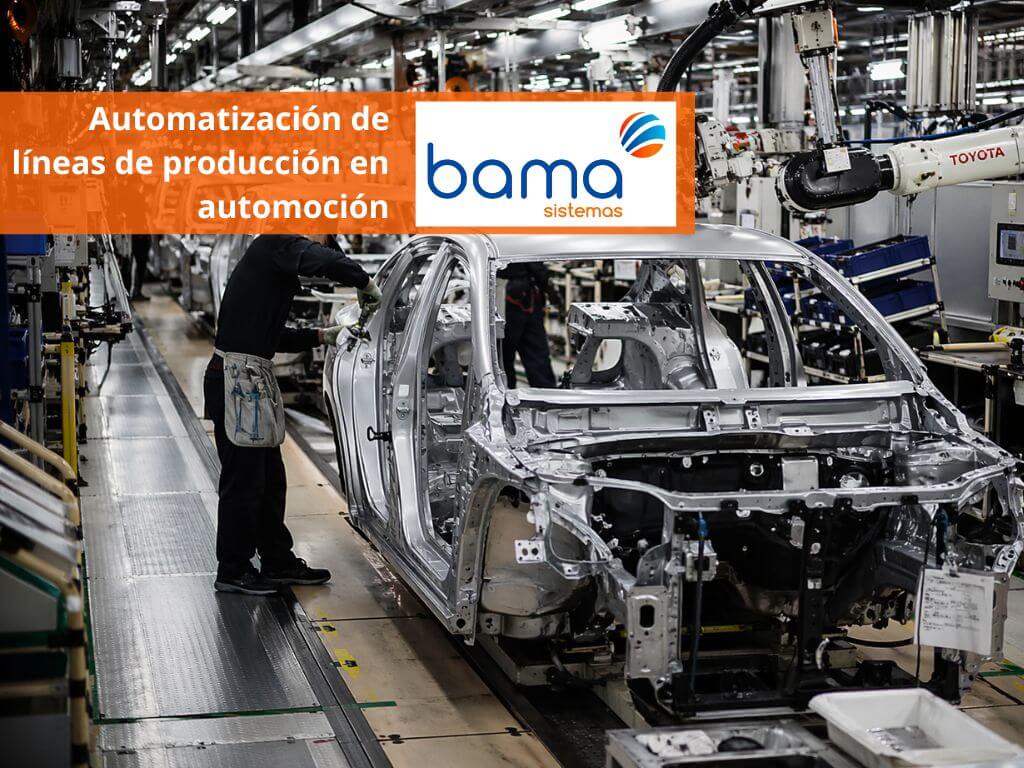
Automotive was the first industry to automate its production lines at massive scale, and it remains the sector with the highest requirements for precision, throughput, and repeatability. However, many plants still operate with manual processes in phases where automotive production line automation would deliver the greatest return.
This article explains which processes to automate, which technologies to apply, and how to execute the project without disrupting your plant’s operations.
What is automotive production line automation?
Production line automation in automotive is the integration of robotics, control systems, and special-purpose machinery to run an automotive plant’s manufacturing processes with consistent precision, sustained throughput, and minimal manual intervention. Its application ranges from stamping parts to end of line, including welding, painting, assembly, and quality control.
Unlike other industrial sectors, automotive requires these systems to operate in sync on continuous production lines, where a failure at one station affects all subsequent stations. That is why automating an automotive production line is not about installing robots in isolation; it is about designing an integrated system where each process connects to the next with no room for improvisation.
Which processes are automated on an automotive production line
Not all processes on a production line deliver the same impact when automated. The highest returns come from those that combine high repetition, tight tolerances, and a high cost of failure. The main ones are:
Automated stamping, welding, and painting
Automated stamping maintains dimensional accuracy over long runs without operational wear. Robotic welding ensures uniform weld beads on every part with exact repeatability. Automated paint booths eliminate inconsistencies in the finish and reduce material waste. All three share one characteristic: any manual variation translates directly into defective parts.
Automated quality control on the production line
Manually inspecting thousands of parts per shift causes fatigue, inconsistency, and defective parts moving on to the next station. Automated quality control detects deviations in real time (dimensional, finish, or assembly-related) before the error multiplies in downstream processes. The difference between detecting a defect at station 3 or at end of line can be the difference between one rejected part and an entire batch being scrapped.
Automated end-of-line processes
Palletizing, packaging, and labeling are the final processes before the product leaves the plant. Automating them ensures full traceability, consistent packaging, and the elimination of identification errors that lead to returns or end-customer penalties.
Key technologies in automotive process automation
Each process on an automotive production line has different requirements. The technology that solves assembly is not the same as the one that manages quality. The main ones are:
Industrial robotics and cobots
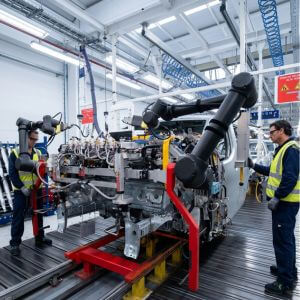
Industrial robotics performs highly repetitive, high-precision tasks: welding, stamping, painting, and palletizing. Cobots work alongside operators in tasks where flexibility matters more than speed, such as subassembly or assisted inspection. The difference between the two is not technological but operational: the industrial robot maximizes throughput, while the cobot maximizes adaptability.
PLCs, SCADA, and MES systems
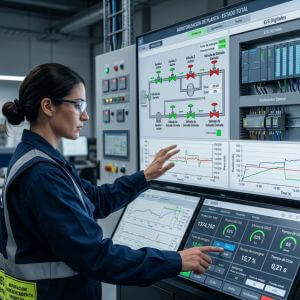
The PLC controls the sequence of operations in each machine. SCADA monitors and visualizes in real time what is happening across the entire line. MES connects production with management: work orders, traceability, and performance by station. All three operate at different layers, but they must be integrated so the line functions as a system rather than a set of isolated machines.
AGVs and internal transport systems
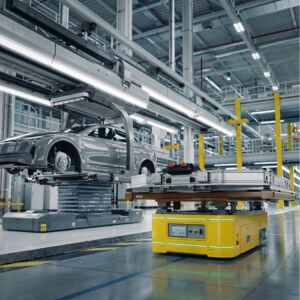
Automated guided vehicles eliminate manual transport of materials between the warehouse and the production line. They run on programmed routes, adapt to the plant’s flow, and ensure continuous supply to each station without human intervention. In plants with high product-mix turnover, they are especially critical to maintain throughput without interruptions.
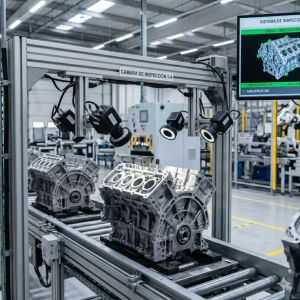
Machine vision and automated inspection
Machine vision systems inspect each part in real time, detecting dimensional, finish, or assembly defects before they move to the next station. Integrating them into the line turns quality control into a continuous, objective process, eliminating the variability of manual inspection and reducing the cost of poor quality.
How to implement an automation project on a production line without stopping the plant
Automating an active automotive production line is the most complex challenge in this type of project. The line cannot be stopped indefinitely, but a new system cannot be installed without validation either. The key is phased planning:
- Analysis of the existing line: before designing any solution, current processes are mapped, bottlenecks are identified, and the stations with the greatest impact on throughput and quality are determined. This step defines the order of intervention.
- Solution design by station: automation is designed station by station, respecting the interfaces with adjacent processes. Each module must integrate with what comes before and what comes after without breaking the line’s flow.
- Off-line manufacturing and testing: systems are manufactured, assembled, and validated in a controlled environment before arriving at the plant. This drastically reduces downtime during the actual installation.
- Deployment during scheduled downtime windows: on-site installation is carried out during planned maintenance stops or shift changes. No improvised interventions that create the risk of unplanned downtime.
- Progressive commissioning: the system is started up gradually, station by station, validating operation under real conditions before integrating the next module.
Successfully deploying an automation project on an active line depends on one factor: phased planning. Analyzing before intervening, manufacturing and validating off-line, and installing during scheduled downtime windows is what determines whether the project moves forward without interruptions or causes unplanned stops that no plant can afford.
Why BAMA is the partner to automate your automotive production line
Automotive is not a sector BAMA entered later. It is the sector where it began. Since 1997, it has delivered projects in plants with the highest performance standards in Spanish industry, and that foundational experience ensures that every technical decision in your project has already been proven under real conditions. You are not working with a supplier that learns alongside you. You are working with a team that already knows your line from the inside.
What sets BAMA apart is not a single capability, but the combination of all of them within one project. From the initial analysis to maintenance of the deployed system, no phase depends on third parties.
- Production line automation: stamping, welding, painting, assembly, and end-of-line processes
- Industrial robotics and cobots: integration at every phase of the process
- Machine vision and automated quality control PLC, SCADA, and MES systems: full integration with plant systems
- Modernization of existing lines: upgrades without the need to deploy from scratch
- Regulations and safety: CE marking on every deployed system
- Certifications: ISO 9001, ISO 14001, Lean Six Sigma, Innovative SME, Siemens SIMOVE
- National and international presence: Madrid, Barcelona, Alicante, Pamplona, and Lisbon
If you are evaluating where to start or how to scale what you already have, BAMA has the experience, the team, and the coverage to support you at every phase of the process.
Would you like to know which automation system best fits your automotive plant?
Low-Medium