Imagine a production line where three axes move simultaneously, without collisions, delays, or errors. That’s not magic: it’s what motion control systems in automation and industrial robotics do when properly implemented.
Currently, organizations integrating advanced motion control technologies can improve the productivity of their automated lines, reduce waste, and increase manufacturing flexibility.
What is Motion Control in automation?
Motion control, known in the industry as Motion Control, is much more than a rotating motor. It is the complete set of technologies that enable the movement of industrial machinery and equipment with millimeter precision, controlling critical variables such as position, speed, acceleration, and torque in real time.
A Motion Control system is not limited to the servomotor or stepper motor. It also includes its control driver, the main controller (usually a PLC), the HMI panel, and all connected peripherals. Everything works together under a single command. As an industry specialist clearly describes it: Motion Control is everything you need to move fast and precisely.
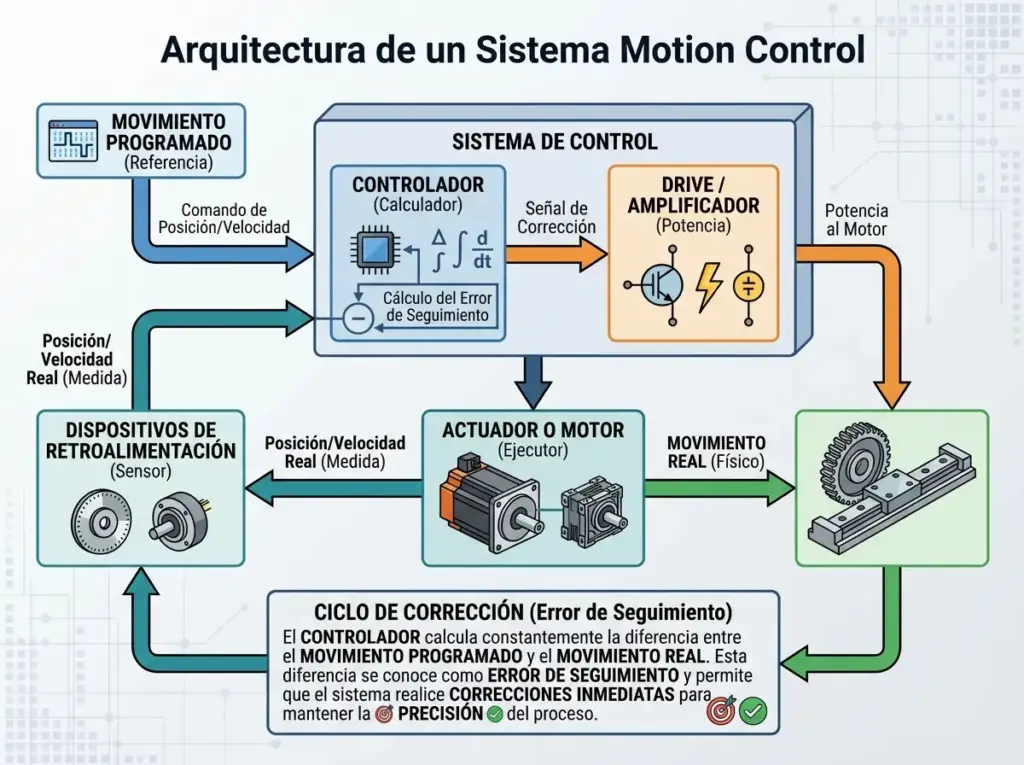
Technically, it operates as a closed-loop system, where three elements interact continuously:
- Actuator: the combination of amplifier (with P, PI, or PID gains), current controller, and transducer (motor).
- Feedback: devices such as encoders or resolvers that transform physical movement into numerical values readable by the system.
- Summing point (Sigma): where feedback is subtracted from the original command to calculate the tracking error, which the system constantly corrects.
This architecture ensures that the machine does exactly what it is commanded to do, not approximately.
How Motion Control Systems Work
Motion control systems combine specialized hardware and software that allow complex movements to be managed with high precision. Their operation is based on the interaction between actuators, feedback sensors, and industrial controllers.
Architecture of a Motion Control System
In a typical system, three fundamental elements are involved:
- Actuator or motor that executes the movement
- Control system that processes information
- Feedback devices that report the actual position
The controller constantly calculates the difference between the programmed movement and the actual movement. This difference is known as tracking error and allows the system to make immediate corrections to maintain process accuracy.
Key Components of a Motion Control System
To understand how to implement or evaluate a motion control solution, it is useful to know its essential building blocks:
| Component | Function in the system |
|---|---|
| Motion Controller | Manages trajectories, calculates control signals, and ensures operational safety |
| Drive or amplifier | Translates controller commands into power signals for motors |
| Actuator (servomotor / stepper motor) | Executes physical movement with high precision |
| Feedback sensors | Encoders and resolvers provide real-time data to maintain the closed loop |
| Mechanical elements | Linear guides, ball screws, and transmission systems adapt movement to the process |
| HMI / User interface | Allows the operator to monitor, adjust parameters, and diagnose faults |
The choice of each component depends on the required precision level, environmental conditions, and available budget. An inadequate motor selection, for example, can compromise both the performance and the return on investment of the entire installation.
Functions of Motion Control in Modern Industry
Motion Control functions go far beyond simple positioning. In a modern industrial plant, these are the capabilities that make an operational difference:
Multi-axis interpolation
A key capability is the simultaneous coordination of multiple axes. This allows different motors to work synchronously to execute complex trajectories.
For example, in Cartesian systems or industrial robots, several axes must move at the same time to generate linear or curved trajectories. This process, known as interpolation, allows fluid and precise movements in three-dimensional spaces.
Axis synchronization
In lines with multiple motors that must operate together, such as a packaging line with product feeding, film feeding, and a rotary knife, the system ensures that all move in coordination, preventing collisions or poorly sealed products.
Electronic Cam
Replaces physical mechanical cams with digitally programmed motion profiles. This allows instant format changes without manual adjustments, with cycle times that can reach 125 microseconds in high-performance systems.
Dual feedback (Dual-loop)
Combines a rotary encoder on the motor (for stability) with a linear encoder on the load (for final position precision). Eliminates errors accumulated by backlash, pitch error, or mechanical flex in the transmission.
Integrated functional safety:
Functions such as Safe Torque Off (STO) allow the motor torque to be safely stopped in an emergency, without the need for additional wiring, and complying with European industrial safety regulations.
Industrial sectors where Motion Control is already standard
The application of motion control systems in industrial robotics and process automation is present in practically all advanced manufacturing sectors:
- Packaging: multi-axis synchronization for high-speed sealing, cutting, and product feeding.
- Automotive: robotic assembly lines with precision positioning for welding, painting, and assembly.
- Pharmaceutical and food industry: dosage, filling, and labeling control with total traceability.
- Textile manufacturing and winding: tension and speed control in continuous processes.
- CNC machinery: axis interpolation for machining components with minimal tolerances.
In all these environments, the key is not just the technology itself, but the ability to integrate it into a scalable platform. A program developed for a mid-range machine can be migrated to higher-performance equipment without rewriting the logic from scratch, which protects the intellectual capital invested in each project.
How to choose a motion control system for your plant
Selecting an appropriate solution requires analyzing the specific needs of each industrial process. Factors such as motion dynamics, the required precision level, or system scalability directly influence the technological choice.
It is also important to consider integration with automation platforms, ease of programming, and the ability to reuse developments in future plant expansions.
BAMA Sistemas: advanced Motion Control solutions for industry
For industrial companies seeking to improve the efficiency of their automated lines, having a specialized technological partner is essential.
BAMA Sistemas offers advanced automation and motion control solutions aimed at optimizing industrial processes, improving production traceability, and increasing operational flexibility.
Thanks to the integration of high-performance controllers, precision servosystems, and unified engineering platforms, it is possible to develop scalable solutions capable of evolving with the needs of each industrial plant.
Do you want to improve the precision, speed, and efficiency of your automated lines?
Our team of specialists will advise you on optimizing your production lines through advanced Motion Control, industrial robotics, and intelligent automation technologies.