A modern production line cannot afford packaging to be its bottleneck. However, in many industrial plants, manual case erecting continues to slow down the pace of the entire operation: operators dedicated to folding, squaring, and sealing cardboard while picking waits, packaging stops, and productivity suffers shift after shift.
An automatic case erecting system eliminates this critical point. Integrated into the production line, it ensures a continuous and stable flow of boxes ready for filling, without interruptions, without squaring errors, and without depending on operator availability.
What is an automatic case erecting system and what is it used for?
In any industrial environment where cardboard boxes are used as secondary packaging, case forming is the first step in the process. Automating it means transforming flat cardboard sheets (blanks) into three-dimensional boxes ready to be filled, without manual intervention during the cycle.
An automatic case erector is an industrial machine designed to:
- Extract the flat cardboard from the magazine.
- Open it and give it a three-dimensional shape.
- Fold the bottom flaps.
- Seal the bottom with adhesive tape or hot melt glue.
- Deliver the box ready for filling at the next station.
Its function within the line is to become the first link in packaging automation, ensuring a constant and uninterrupted flow to the rest of the process.
How does an automatic case erector work in a production line?
Understanding its operation is key to evaluating its real impact on productivity.
- Storage and Feeding
Folded cardboard blanks are stacked vertically in a side magazine. A vacuum suction cup system extracts each blank individually and transfers it to the opening area. - Opening and Squaring
The flaps are folded in the correct order. First the minor flaps, then the major flaps, and are secured with adhesive tape or hot melt glue, depending on the equipment configuration. - Bottom Flap Folding and Sealing
The flaps are folded in the correct order and sealed with tape or hot melt glue. - Outfeed Conveyor
The formed box is sent to the conveyor for manual or robotic filling.

Components that make up the automatic case erecting system
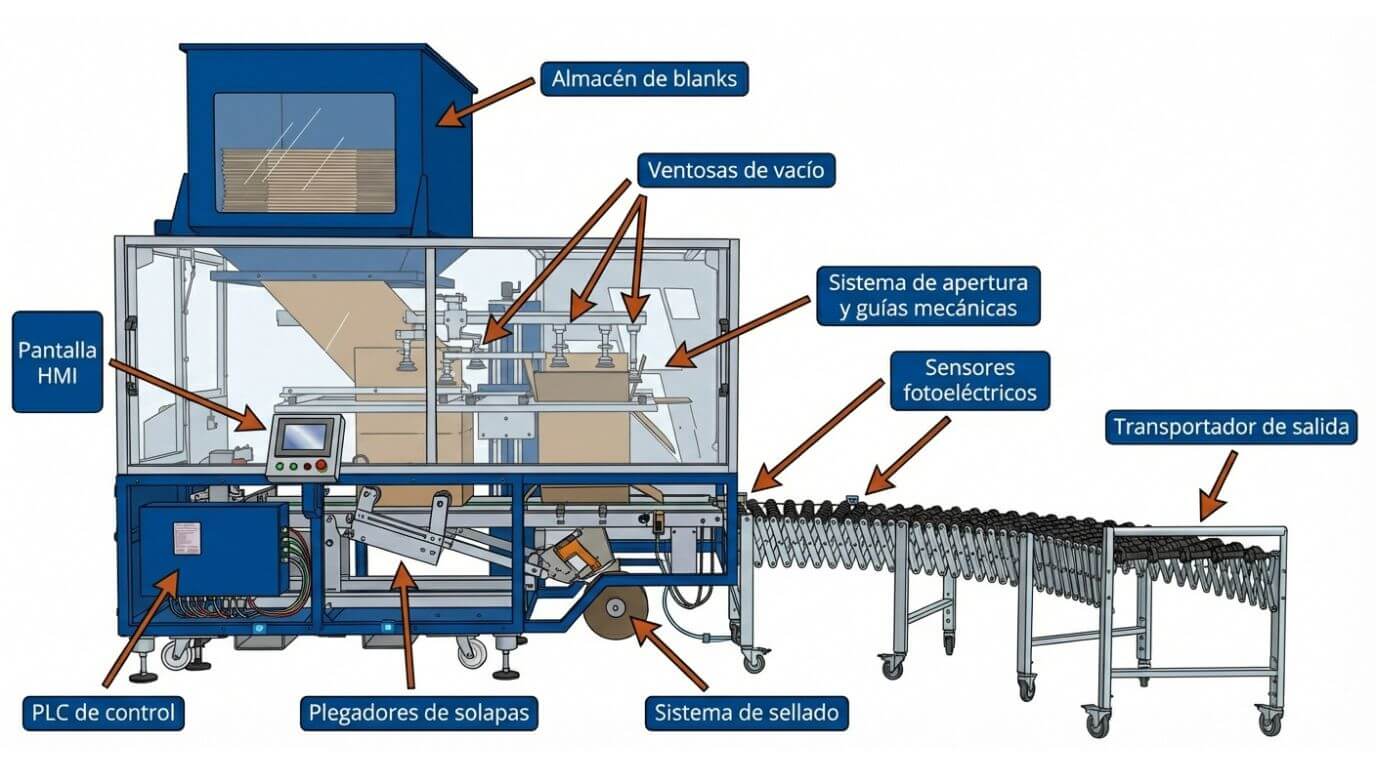
Beyond the operational process, it is essential to understand the internal architecture of the equipment. These are the elements that guarantee precision, stability, and continuous performance in an industrial case erecting machine:
- Blank Magazine: storage where flat blanks are stacked. It can be side or front loaded depending on the model.
- Vacuum Suction Cups: pick up and extract one blank at a time. They are the component with the most wear and require periodic inspection.
- Opening System and Mechanical Guides: open the cardboard and square it with millimeter precision.
- Flap Folders: fold the bottom flaps in the correct sequence before sealing.
- Sealing System: hot melt glue guns or adhesive tape heads to close the bottom.
- Control PLC: the electronic system that coordinates all equipment movements. Common brands: Siemens, Allen-Bradley, Mitsubishi.
- HMI Screen: touch interface for selecting formats, adjusting parameters, and consulting diagnostics.
- Photoelectric Sensors: detect blank presence, flap position, and magazine level.
- Outfeed Conveyor: transports the formed box to the next station in the line.
This assembly allows for high industrial speeds and maintains stability in high-volume processes.
Types of boxes compatible with the automatic erecting system
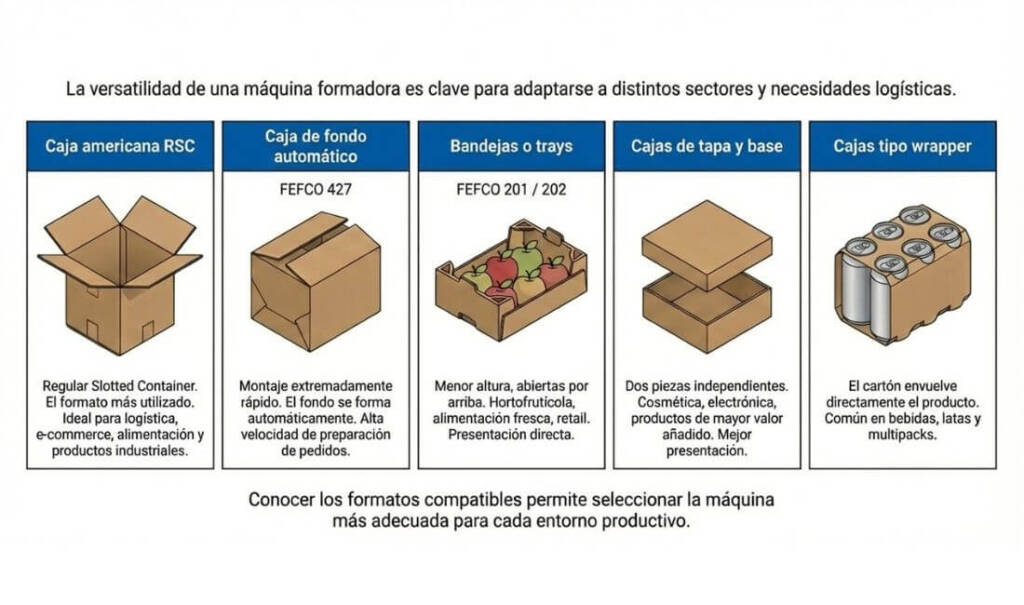
Format versatility is a determining factor when selecting equipment. The main types of packaging that an automatic erector can produce are:
RSC (Regular Slotted Container) American Box
It is the most widely used format in the industry. It has four top and four bottom flaps that overlap for closure. It is ideal for logistics, e-commerce, food, and industrial products.
Its compatibility with most automatic lines makes it the market standard.
Auto-lock Bottom Box (FEFCO 427)
This type of box allows for extremely fast assembly, as the bottom is automatically formed when the blank is unfolded.
It is widely used in operations requiring high order preparation speed.
Trays (FEFCO 201 / 202)
Lower height boxes, open at the top, frequently used in sectors such as fresh produce, food, and retail.
They allow for direct product presentation and facilitate replenishment at the point of sale.
Lid and Base Boxes
Composed of two independent pieces, they are common in cosmetics, electronics, and higher value-added products.
They offer better presentation and greater aesthetic protection.
Wrapper-style Boxes
In this format, the cardboard directly wraps the product. It is common for beverages, cans, and multipacks.
Knowing the compatible formats allows for correct selection of the most suitable automatic cardboard case erector machine for each production environment and ensures maximum efficiency in the packaging line.
Advantages of integrating an automatic erecting system into your production line
Automation is not just about speed. It is a strategic decision with a direct impact on profitability and competitiveness:
- Reduction of Labor Costs: eliminates repetitive tasks and allows personnel to be reallocated to higher-value functions.
- Increased Productivity: constant and predictable pace, without pauses or human variability.
- Perfectly Formed Boxes: fewer squaring and sealing errors that affect packaging integrity.
- Improved Workplace Safety: repetitive movements associated with musculoskeletal injuries are eliminated.
- 24/7 Operability: especially relevant for e-commerce, pharmaceuticals, and continuous production.
- Full Integration into Automatic Line: communicates with the rest of the line via standard industrial protocols.
When volume exceeds certain production levels, automation ceases to be an option and becomes a real competitive advantage.
How to integrate an automatic cardboard case erector machine into your production line
A case erector does not work in isolation. Its true potential appears when integrated into a complete solution:
Erector → Filling / Pick & Place → Case Sealer → Labeler → Palletizer
If you are evaluating complete process automation, you can learn more about industrial end-of-line solutions that integrate forming, sealing, labeling, and palletizing into a single optimized architecture.
Additionally, it can communicate with the rest of the line using industrial protocols (PROFIBUS, EtherNet/IP, OPC-UA) and connect to MES or ERP systems to monitor production, OEE, and downtime in real time.
In highly automated environments, the erector can be integrated with collaborative robots (cobots) to create compact and fully autonomous packaging cells.
Key factors before investing in an automatic case erecting system
Before making an investment decision, it is advisable to analyze these factors in detail:
- Volume of boxes per hour or per shift: the most determining criterion for choosing the level of automation.
- Variety of formats: if you work with many different sizes, a multi-format machine with servomotors is the most efficient option.
- Box type: not all equipment supports all box styles. It is essential to validate compatibility.
- Sealing system: hot melt for greater strength and speed; adhesive tape for lower maintenance cost.
- Available floor space: automatic erectors need additional space for the blank magazine and side technical access.
- Working environment: cold rooms, humid areas, or the food industry may require stainless steel models.
- Technical service and spare parts availability: a critical factor in case of a breakdown affecting the entire line.
A prior technical audit prevents both oversizing and undersizing the solution, and ensures that the investment aligns with actual production objectives.
BAMA: Automatic Solutions for Case Erecting
Automating case erecting is not just an operational improvement: it is the foundation for building more efficient, safer, and scalable plants.
If boxes are still being formed manually in your warehouse or factory, you are probably losing productive capacity every day. Incorporating the right industrial case erector allows you to stabilize processes, reduce errors, and prepare your company for an increasingly demanding and competitive environment.
At BAMA, we analyze each case technically and personally, evaluating volumes, formats, and production objectives to propose the most efficient and scalable solution for your plant.
The question is not whether you should automate, but when you want to start optimizing your line.
Do you want to know which equipment best suits your production?
Low-Medium