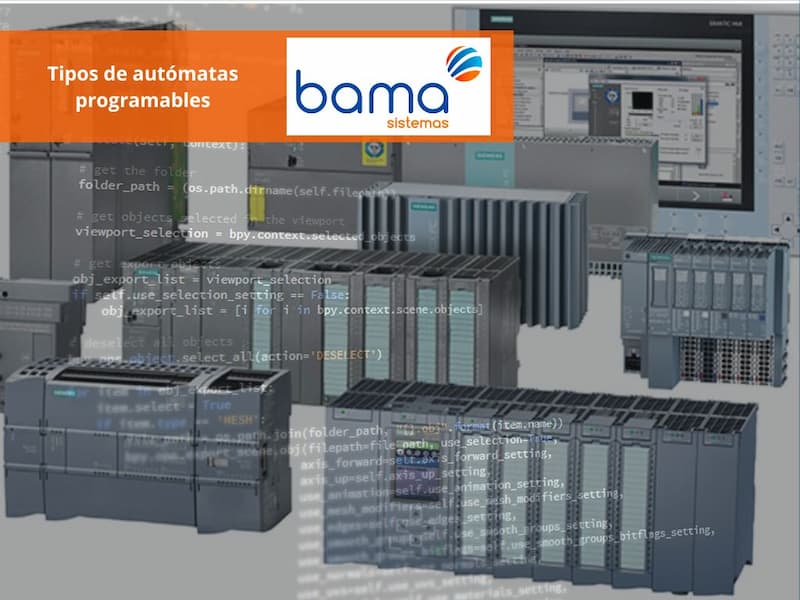
Programmable Logic Controllers or PLCs (from the English Programmable Logic Controllers) are essential tools in industrial automation. These devices control and monitor processes, from the simplest to the most complex, ensuring precision, efficiency, and safety in sectors such as manufacturing, energy, and logistics.
However, not all PLCs are the same. Depending on the application, environment, and objectives, it is crucial to choose the appropriate type of PLC. Understanding the differences between types of programmable logic controllers allows companies to optimize their processes, reduce costs, and increase their competitiveness.
In this article, we will explore the main classifications of PLCs, from their structure and processing capacity to their programming method and adaptability to specific environments.
Classification by Structure
The structure of a Programmable Logic Controller (PLC) determines how its components are organized and, consequently, how it can be integrated into an automation system. Based on their design or structure, PLCs are classified into two main categories:
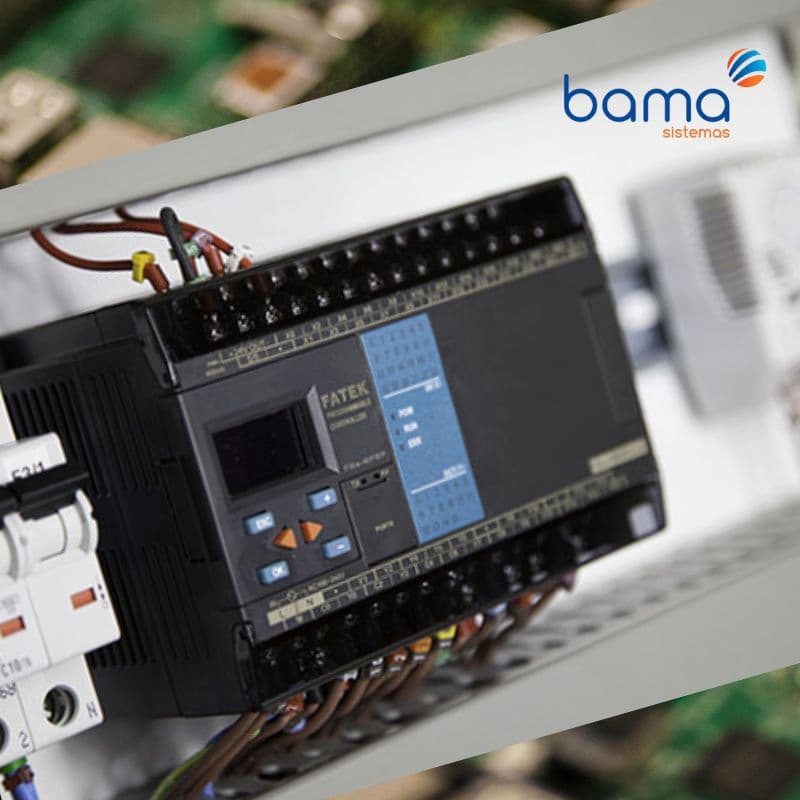
Compact PLCs
Compact PLCs group all essential components—CPU, inputs and outputs (I/O), and power supply—into a single unit. This simplified design makes them ideal for applications where space is limited or the system does not require many connections.
- Common Applications: Automation of small machines, lighting control, automated irrigation systems.
- Advantages:
- Lower initial cost.
- Easy installation and configuration.
- Occupy less physical space.
- Limitations:
- Limited capacity to expand the number of inputs or outputs.
- Less flexibility for future needs.
Modular PLCs
Modular PLCs are composed of independent modules that connect to each other. Each module has a specific function, such as a processor (CPU), I/O modules, power supplies, or communication interfaces.
- Common Applications: Complex systems such as production lines, water treatment plants, or logistics systems.
- Advantages:
- Great flexibility: modules can be added or removed as needed.
- High expansion and customization capacity.
- Ideal for systems that grow over time.
- Limitations:
- Higher initial cost.
- Require more physical space for installation.
The choice between a compact PLC or a modular PLC depends on the complexity of the system to be automated. While compact PLCs are perfect for small and specific applications, modular PLCs offer a scalable solution for more complex systems.
Classification by Application
Programmable Logic Controllers (PLCs) are widely used in industry due to their ability to adapt to different needs. Depending on their application, they can be classified into several categories that address specific functions within automated systems.
Safety PLCs
Safety PLCs are designed to ensure the safe operation of machines and processes in industrial environments. They incorporate advanced functions to monitor and respond to critical situations, such as emergencies or operational failures.
Main characteristics:
- Integration of safety functions, such as emergency stops and access control.
- Compliance with industrial safety regulations.
- High reliability in environments where the protection of people and equipment is a priority.
High-Speed PLCs
High-speed PLCs are devices designed to process signals and execute instructions with extremely fast response times. They are essential in applications where processes require precise synchronization.
Main characteristics:
- Ability to handle large volumes of data in real-time.
- Used in applications such as sorting systems, packaging machinery, or high-speed production lines.
- High precision in controlling devices and processes.
Classification by Communication Capability
Programmable Logic Controllers (PLCs) are also distinguished by their ability to communicate with other devices and systems within an industrial network. This feature is essential in environments where data integration and real-time monitoring are priorities.
PLCs with Integrated Communication
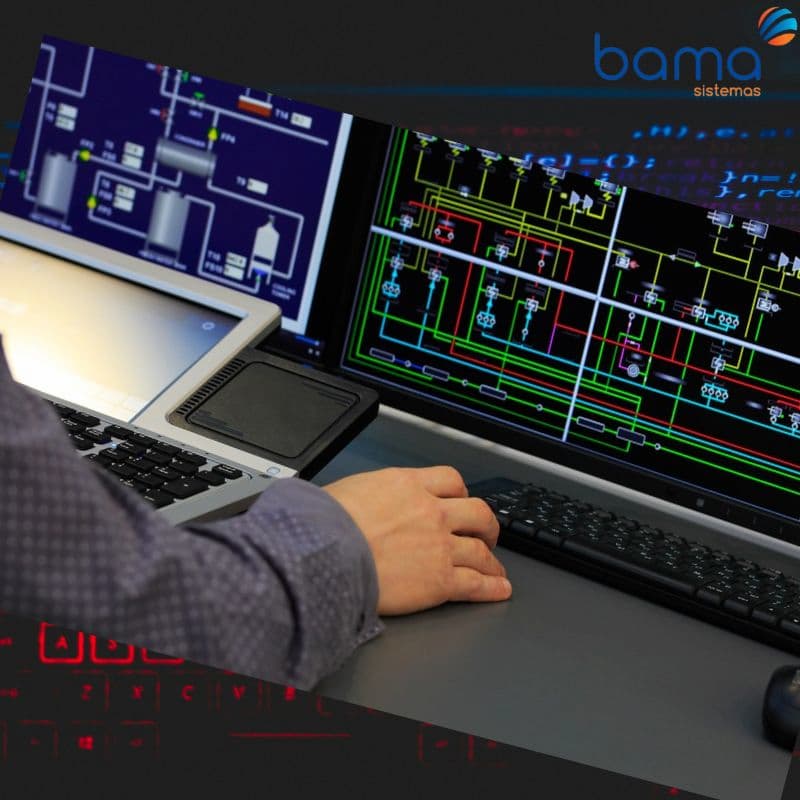
PLCs with integrated communication feature specific interfaces that allow them to connect directly with other devices, industrial networks, or advanced control systems such as SCADA (Supervisory Control and Data Acquisition).
Main characteristics:
- Incorporate standard industrial communication protocols, such as Modbus, Ethernet/IP, or Profinet.
- Ability to monitor and control processes remotely.
- Compatibility with centralized monitoring systems, which improves operational efficiency.
Autonomous PLCs
Unlike previous models, autonomous PLCs are designed to operate independently, without the need to connect to external networks or systems. They function as standalone solutions for specific tasks.
Main characteristics:
- Independent operation from other systems.
- Frequently used in simple or isolated applications, such as controlling a specific machine.
- Lower complexity in their configuration and operation.
Classification of PLCs by Growth Capacity
Programmable Logic Controllers (PLCs) can be classified according to their ability to adapt to the changing needs of the systems in which they are integrated. This growth capacity, which includes both scalability and expansion possibilities, determines whether a PLC can adjust to more complex or demanding projects over time.
Compact PLCs (Non-Expandable)
Compact PLCs are fixed-configuration devices that integrate all essential elements into a single unit. Their design is intended for specific applications that do not require future expansions.
- Main characteristics:
- Closed configuration, with no possibility of adding additional modules.
- Compact and easy to install.
- Suitable for specific tasks with stable requirements.
- Application Example:
- Control of simple machinery, such as a packaging machine.
- Automation of lighting systems in a building.
Modular PLCs (Expandable or Scalable)
Modular PLCs stand out for their flexible design, which allows for the incorporation of new modules according to system needs. This makes them ideal for constantly evolving industrial environments.
- Main characteristics:
- Possibility of adding input/output, communication, or advanced function modules.
- High flexibility to adapt to growing projects.
- Ability to manage larger-scale applications.
- Application Example:
- Automation of production lines with multiple stages.
- Energy systems with integrated remote monitoring and data analysis.
Classification by Programming Method
Programmable Logic Controllers (PLCs) use different programming methods, allowing them to be adapted to the specific needs of industrial processes. These methods are based on standards defined by IEC 61131-3, which establish five main programming languages.
Ladder Programming (LD)
Ladder programming (also known as ladder logic) is a graphical language inspired by electrical relay diagrams. It is one of the most widely used methods due to its ease in representing logical processes.
Main characteristics:
- Clear visual representation, with contacts and coils simulating electrical circuits.
- Ideal for simple sequential processes.
- Easy to understand for technicians familiar with electrical schematics.
Structured Text (ST)
Structured Text is a textual language similar to high-level programming languages like Pascal or C. It is especially useful for complex tasks and advanced mathematical operations.
Main characteristics:
- Allows writing complex algorithms with a high degree of detail.
- Suitable for advanced calculations and processes requiring extensive conditional logic.
- Steeper learning curve compared to Ladder.
Function Block Diagram (FBD)
The Function Block Diagram uses graphical blocks to represent functions, inputs, and outputs. It is an intuitive and visually appealing language, especially useful for continuous control tasks.
Main characteristics:
- Use of interconnected blocks to represent logical or mathematical operations.
- Easy to interpret and debug.
- Suitable for applications where multiple functions are combined.
Instruction List (IL)
The Instruction List is a language based on sequential commands similar to assembly language. Although less intuitive, it offers detailed control over operations.
Main characteristics:
- Compact syntax, with instructions executed line by line.
- More technical use, ideal for low-level optimization.
- Less common in modern applications due to preference for graphical languages.
Sequential Function Chart (SFC)
The Sequential Function Chart divides processes into stages or steps, represented graphically, which facilitates the programming of systems with multiple states.
Main characteristics:
- Clear representation of states and transitions.
- Useful for processes that require sequential actions.
- Excellent for automating complex machinery.
Each programming method offers specific advantages depending on the system’s needs and the process’s complexity. Ladder and FBD programming are ideal for visual and sequential tasks, while Structured Text and the Instruction List excel in more complex and detailed operations.
Classification of PLCs by Application Environment
Programmable Logic Controllers (PLCs) are designed to adapt to different industrial conditions. Depending on the environment in which they operate, they are classified into devices for standard environments and for critical industrial conditions.
PLCs for Industrial Environments
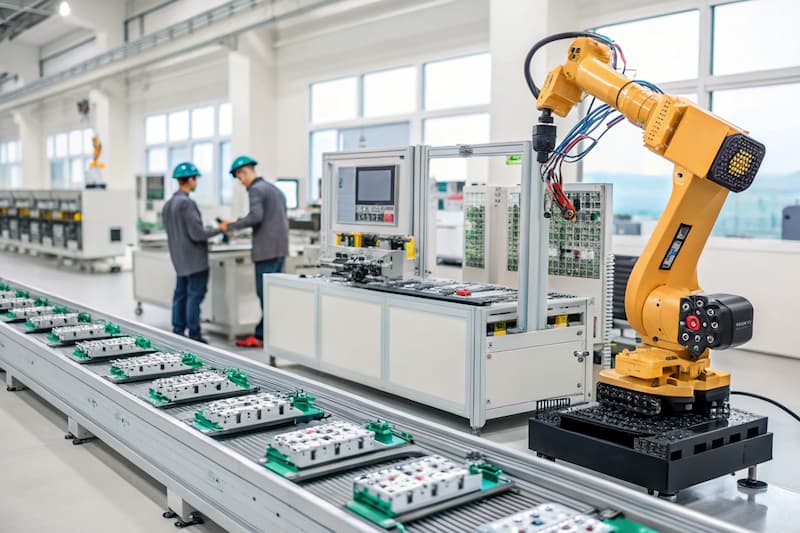
These PLCs are prepared to operate in normal factory conditions, where environmental factors such as temperature, dust, or humidity are moderate and controlled.
- Main characteristics:
- Reliable operation in environments with regular characteristics.
- Widely used in production lines, logistics systems, and manufacturing plants.
- Incorporate basic protections to ensure stability and safety.
- Application Example:
- Control of assembly lines in an electronics factory.
- Management of conveyor belts in an automated warehouse.
PLCs for Harsh Industrial Conditions
These PLCs are designed to operate in more complex and challenging environments, where external factors such as extreme temperatures, dust, humidity, or constant vibrations require a more robust design.
- Main characteristics:
- Reinforced structure to resist dust, water, and other external agents (complying with standards like IP67).
- Ability to operate in wide temperature ranges and under constant vibrations.
- Durability against chemical substances and corrosive environments.
- Application Example:
- Monitoring processes in a waste treatment plant.
- Automation of equipment in an underground mine.
- Control of systems on offshore oil platforms.
Main Manufacturers and Models of PLCs
| Manufacturer | Most Representative Models |
| Siemens | SIMATIC S7-1500, SIMATIC S7-1200, LOGO! 8 |
| Rockwell Automation (Allen-Bradley) | ControlLogix, CompactLogix |
| Schneider Electric | Modicon M340, Modicon M221 |
| Omron | CJ2M, CP1L |
| Mitsubishi Electric | MELSEC iQ-R Series, MELSEC FX Series |
Programmable Logic Controllers (PLCs) are the backbone of modern industrial automation. Understanding their different classifications—whether by structure, communication capability, programming method, or adaptability to demanding environments—is key to recognizing the possibilities they offer in improving industrial processes.
At BAMA Sistemas, we not only know every detail of PLCs, but we also transform that knowledge into customized solutions for our clients. With years of experience in automation and industrial robotics, we help optimize processes, increase efficiency, and ensure exceptional results.
Do you want to take your system to the next level?
Trust experts who understand automation from start to finish. Contact us today and discover how we can help you program, optimize, and transform your industrial systems.
Frequently Asked Questions about PLC Types or Controllers
1. What type of PLC is most suitable for a company that is just starting to automate?
To begin with automation, compact PLCs are usually the best option. They offer ease of installation, lower cost, and are suitable for specific tasks without the need for future expansions. As the system grows, migrating to a modular PLC can be considered.
2. Can I switch from a compact PLC to a modular one without redesigning the entire system?
It is not always necessary to redesign everything. In many cases, it is possible to plan a progressive transition, maintaining part of the infrastructure and adapting the modular system according to new needs. A prior technical analysis is key to doing this efficiently.
3. How important is the industrial environment when choosing a type of PLC?
The environment influences the choice of PLC. An environment with controlled temperature is not the same as one with humidity, dust, or vibrations. Choosing a PLC suitable for the environment ensures durability, reliability, and regulatory compliance.
4. Is it necessary to know several programming languages to work with different types of PLCs?
Knowing several languages expands possibilities, as some manufacturers or applications require one or another. Mastering at least Ladder, FBD, and Structured Text allows addressing most industrial projects with technical proficiency.
5. What advantages does a modular PLC offer over a compact one in a long-term project?
A modular PLC allows the system to scale as the plant’s needs grow. New modules can be added without replacing the entire equipment, which represents a more efficient investment and greater technical adaptability.
6. Are high-speed PLCs necessary in all industrial installations?
Not necessarily. They are only essential in processes that require immediate responses and precise synchronization, such as in packaging or rapid sorting lines. For less demanding tasks, a standard PLC is usually sufficient.
7. How can Bama help in choosing the most suitable type of PLC for each project?
At Bama Sistemas, we conduct a technical analysis of the specific needs of each client and environment. From there, we recommend the most suitable type of PLC and integrate it with customized solutions to optimize processes and ensure maximum efficiency.