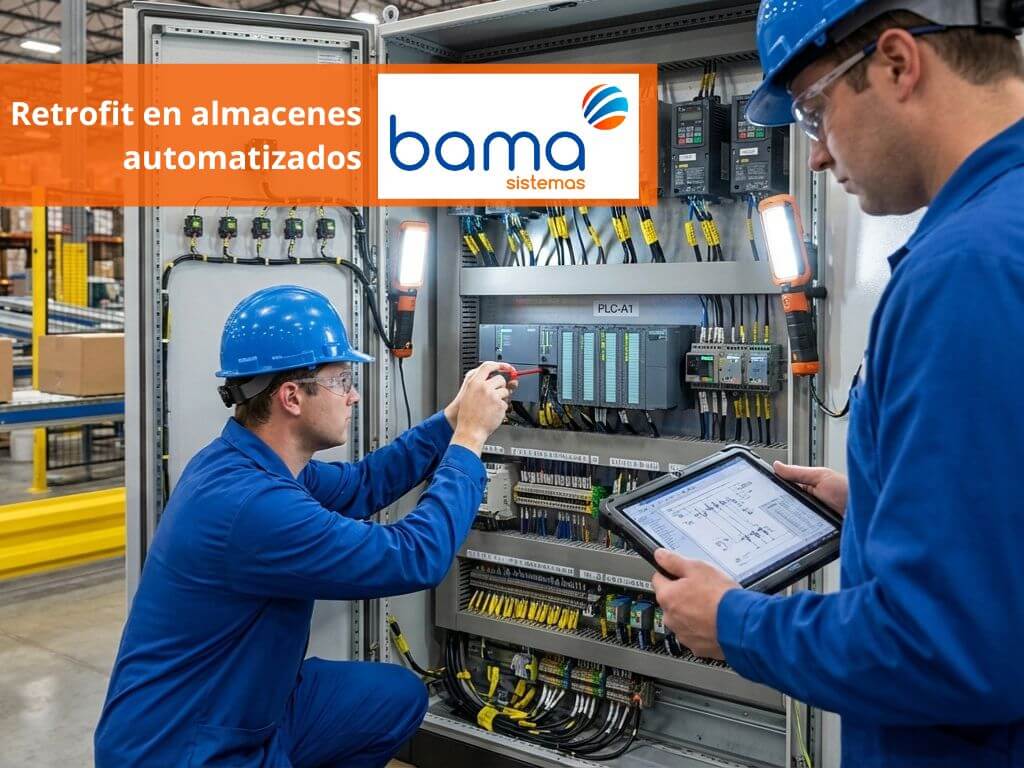
Modernizing a warehouse without having to build a new one is possible thanks to retrofit in automated warehouses. This strategy extends the service life of the facilities, increases efficiency, and reduces costs, all with a controlled investment.
In this article, which serves as a guide developed by Bama Sistemas, we take an in-depth look at what it is, how it is applied, and why more and more industrial companies in Spain are choosing this smart solution.
What is retrofit in automated warehouses?
Retrofit, also known as warehouse refurbishment, involves upgrading the technological components of an existing automated storage system while keeping its basic infrastructure (racking, structures, conveyors). Instead of replacing the entire system, key elements such as PLCs, sensors, variable frequency drives, SCADA systems, and control software are replaced.
Differences between retrofit and a full rebuild
Unlike a full rebuild, retrofit makes it possible to keep 60–80% of the existing infrastructure, reducing implementation time and capital investment costs. It also avoids long periods of downtime by being implemented in phases.
Why is it a cost-effective option for industrial companies?
It is ideal for warehouses that are 10–20 years old, where the mechanics are still functional but the electronics are obsolete. It is a way to adapt logistics to Industry 4.0 without major investment.
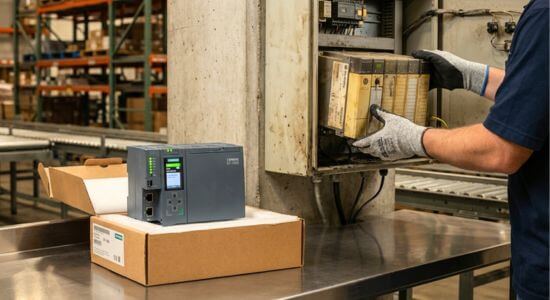
What does modernizing automated warehouses involve?
Modernizing automated warehouses through retrofit involves a series of structured steps and key technical decisions.
Key components upgraded in an automated warehouse (PLC, sensors, drives, software)
The most common elements to modernize include:
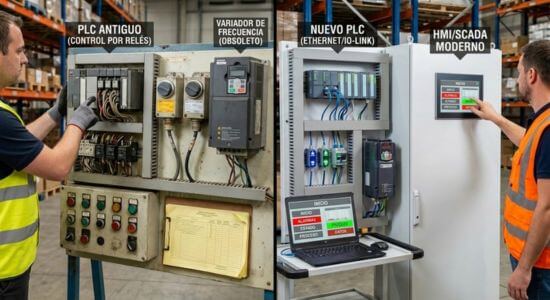
- PLCs: These are programmable logic controllers that act as the brain of the automated system. Upgrading them involves moving from older models to more powerful, modern units capable of handling more signals, with Ethernet/IP connectivity and integrated safety and diagnostics features. This not only improves performance and processing speed, but also enables seamless integration with management systems such as WMS or ERP.
- Variable frequency drives (VFDs): Their function is to control the speed and torque of electric motors. Upgrading to high energy-efficiency models (IE4/IE5 classes) enables more precise acceleration and braking control, less mechanical wear, reduced consumption peaks, and the possibility of energy recovery in downhill applications. This translates into energy savings of between 20% and 40%, especially useful in continuous conveying systems.
- Sensors and vision systems: Analog or basic sensors are replaced with smart solutions featuring IO-Link technology, machine vision, and 2D/3D readers. This enables greater accuracy in product detection, goods traceability, and self-diagnostics capability. In addition, the use of RFID scanners and cameras facilitates real-time control of operations, reducing human error and improving process safety.
- SCADA and WMS: These control and supervision systems are upgraded to incorporate modern features such as intuitive HMI interfaces, predictive analytics, and M2M connectivity. An advanced SCADA enables remote monitoring of equipment status, automatic alerts, and performance analysis, while a modern WMS optimizes picking routes, manages inventory in real time, and integrates with ERP platforms, improving decision-making and warehouse scalability.
Integration with existing systems without stopping operations
The key to success is a planned execution that allows the warehouse to keep operating while it is modernized in stages, making use of scheduled shutdowns.
Benefits of warehouse refurbishment
Modernizing through retrofit not only saves money, but also improves many operational and strategic aspects.
Extended service life of the facility
Refurbishment can extend the warehouse’s operating life by up to 15–20 more years by leveraging its mechanical base. This is especially useful in structurally well-designed facilities, where the initial infrastructure investment is still valid. In this way, the historical return on the original investment is maximized by extending its productive use.
Cost reduction and return on investment
Thanks to component optimization, reduced energy consumption, and less downtime, ROI is achieved within 2 to 5 years. This is complemented by lower maintenance expenses, reduced wear on critical parts, and greater operational efficiency that lowers the cost per order processed. In addition, it is often possible to access grants or European funds that improve the project’s profitability.
Improvements in safety, efficiency, and maintenance
Refurbished systems often incorporate safety barriers, improved emergency stops, and stricter secure industrial communication protocols. This helps meet regulations such as RD 1215/1997 and European standards (ISO 13849, IEC 62061), strengthening personnel protection. Operationally, upgraded systems detect faults before they become major stoppages, enabling more effective predictive maintenance. Human errors are also reduced thanks to more intuitive interfaces and smart automation.
Flexibility for future expansions
The modular architecture of new systems makes it possible to scale or adapt the warehouse to new logistics needs, such as an increase in SKUs, layout changes, or the integration of collaborative robots. This flexibility reduces the cost and time of future expansions, as there is no need to redesign the system from scratch. It also makes it easier to adapt to changes in market demand or new technology standards.
Is it cost-effective to apply retrofit to automated warehouses?
This section answers the most common financial questions from logistics and industrial managers.
Cost vs. full replacement
A retrofit can cost between 30% and 60% less than building a new warehouse, not including the savings from not stopping production activity.
Practical cases and real results
Various Spanish companies have modernized their warehouses, achieving energy savings of 20–40%, fewer logistics errors, and improved traceability.
Profitability indicators and key metrics
KPIs such as system availability (>99.5%), energy consumption, cycle times, and error rate improve significantly.
How to choose a retrofit provider for your warehouse (why choose BAMA)
Choosing the right provider is crucial to ensure successful and sustainable results. Bama Sistemas has extensive experience in modernizing automated warehouses, offering tailored solutions for each type of facility. Its projects are delivered in phases, adapting to each client’s planned shutdown windows to minimize operational impact. In addition, it provides post-project technical support, ensuring ongoing assistance, spare parts availability, and future upgrades that safeguard the sustainability of the investment.
Upgrade your warehouse and improve your KPIs
Low-Medium