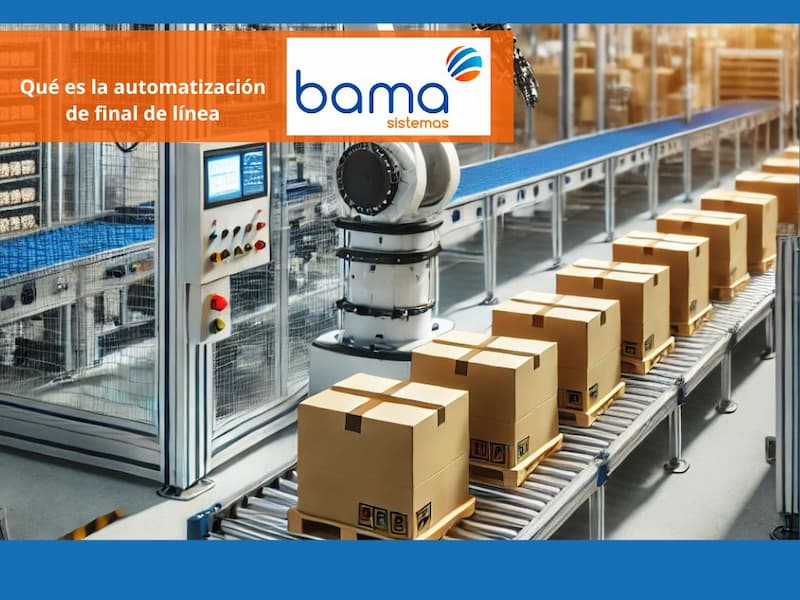
A very common question is: What is end-of-line automation. More and more companies are asking this as they seek to optimize their production processes. Understanding its scope and possibilities is key to seeing how technology can transform the final stage of production.
End-of-line automation is much more than a technological advancement; it is a strategic necessity for any industry looking to grow and adapt to a competitive market. Implementing it not only improves internal processes but can also make the difference between a company that leads in efficiency and quality and one whose margins prevent it from competing in the market.
Below, we explain what it consists of and why it has become an essential solution for the industry.
What end-of-line automation consists of
End-of-line automation consists of the integration of advanced technologies that optimize final production tasks. These stages include processes such as packaging, palletizing, labeling, and quality inspection.
Instead of being performed manually, these tasks are executed through automated systems designed to work continuously and precisely, guaranteeing both product quality and process efficiency.
Essential components of end-of-line automation
- Programmable Logic Controllers (PLCs): These are the brain of the system, controlling and supervising each stage of the process through programmed logic.
- Industrial robots: Specialized in specific tasks, such as product handling or stacking on pallets.
- Machine vision systems: These verify product quality in real time, detecting defects or errors. They also act as the eyes of the system, detecting where each element is located, its position, etc.
- Automated conveyors: These move products from one point to another quickly and accurately.
- Safety systems: These ensure that workers and equipment are protected during operation.
Advantages of end-of-line automation
The implementation of these technologies brings numerous benefits that justify the investment:
1. Increased productivity
Automated systems can operate 24/7 without the need for breaks, significantly increasing production volume.
2. Consistency and product quality
Automation minimizes human error, ensuring that each product meets established standards.
3. Reduction in operating costs
Although the initial investment may be high, in the long run, costs are saved on labor, material waste, and downtime.
4. Improved occupational safety
Repetitive or dangerous tasks are taken over by machines, minimizing risks for workers.
How to implement end-of-line automation
The success of automation depends on strategic planning with the following steps:
- Initial diagnosis: Evaluation of the needs and capabilities of the current production line.
- Custom design: Automation experts coordinate to develop a personalized solution.
- Technology selection: Appropriate equipment and systems are chosen for specific end-of-line tasks.
- Training: Staff training to manage the automated systems.
- Monitoring and optimization: Analysis systems are implemented to identify opportunities for improvement.
Trends and innovations in end-of-line automation
Technology advances rapidly and transforms automation:
- Artificial Intelligence (AI): Allows systems to adapt to changes in real time.
- Integration with Industry 4.0: Interconnection of equipment through IoT for centralized management.
- Collaborative robots (cobots): Designed to work alongside humans safely.
Practical examples of end-of-line automation
1. Food industry: automatic palletizing of packaged products
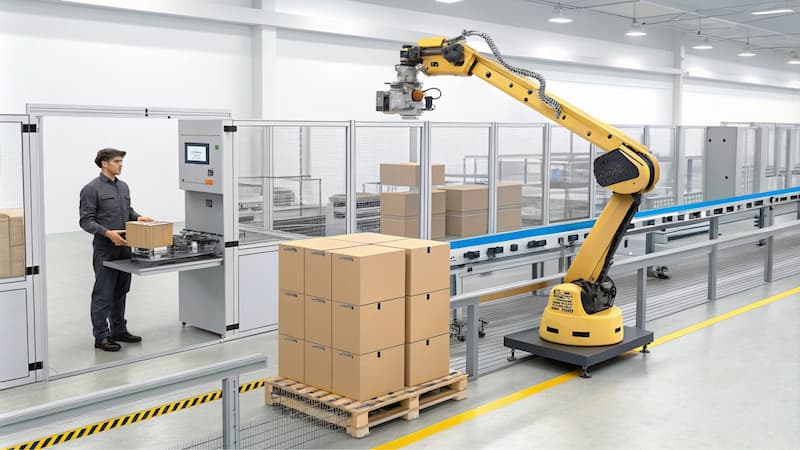
In a food production plant, packaged products, such as boxes of cookies or bags of flour, are automatically transported to a palletizing station. Here, an automated system organizes the boxes on pallets with millimeter precision, optimizing available space and ensuring stability for transport. Intelligent sensors monitor alignment and detect potential errors to correct them instantly.
Results:
- Increased productivity: Reduction in the time required to complete palletizing.
- Consistency: Uniformly organized pallets, ready for shipment.
- Better occupational safety: Elimination of the need to handle heavy loads manually.
2. Pharmaceutical industry: automated labeling and quality inspection
In a pharmaceutical production line, each container passes through an automated system that prints personalized labels with information such as batch number and expiration date. A machine vision system verifies that each label is correctly placed and that there are no errors in the text. Simultaneously, a final inspection is performed to detect defects in the containers before packaging.
Results:
- Quality assurance: All containers meet the most demanding standards.
- Regulatory compliance: Clear and accurate labels that ensure traceability.
- Operational efficiency: Higher speed and fewer errors than in manual processes.
3. Automotive industry: handling of heavy components
In an automotive parts factory, bulky components, such as engine blocks, are handled by automated handling systems. Robotic arms lift, move, and position each piece on the pallets, ensuring they are stored safely for transport. This system is designed to adapt to different sizes and weights, allowing for flexibility in production.
Results:
- Improved efficiency: Faster processes and fewer interruptions.
- Occupational safety: Reduction in the risk of injuries related to manual handling of heavy parts.
- Consistency: Each component is placed with precision, avoiding damage during storage and transport.
These examples highlight how end-of-line automation can transform the operations of any industry, maximizing efficiency and minimizing errors. Each solution is adapted to the specific needs of each sector, guaranteeing optimal results for both production and occupational safety.
We hope you found this article of interest.
If you need any additional information to implement automation in your end-of-line processes, please do not hesitate to contact us.
Frequently asked questions about end-of-line automation
1. How do I know if my company needs to automate the end of the line?
When you detect bottlenecks at the production output, frequent errors in packaging or palletizing, or excessive labor in repetitive tasks, it is a clear sign that end-of-line automation can significantly improve efficiency and reduce costs.
2. What type of technology is essential in an end-of-line automation solution?
A complete proposal should include PLCs for control, industrial robots or cobots for handling, machine vision for inspection, automated conveyors for transfer, and safety systems that protect both personnel and equipment.
3. Is it profitable to automate the end of the line in my company?
Yes. Despite the initial investment, benefits such as continuous production, error reduction, lower labor costs, and improved safety mean that the payback is fast and real, especially in plants with high output volumes.
4. How can I adapt my current system to end-of-line automation?
It is possible to adapt the existing installation through a technical diagnosis, designing a progressive integration with automated modules, avoiding major renovations and facilitating an agile and efficient transition.
5. What advantages does artificial intelligence (AI) provide at this stage of the process?
AI allows automated systems to respond in real time to variations, such as format changes or defect detection, improving quality, reducing waste, and optimizing consistency in each final product.
6. Can end-of-line automation improve occupational safety?
Yes, by automating repetitive or dangerous tasks such as palletizing or packaging, injuries are reduced, operator fatigue is minimized, and a safer, more ergonomic work environment is created.
7. How can Bama Sistemas help me with end-of-line automation?
At Bama Sistemas, we design custom solutions, from initial diagnosis to commissioning, integrating advanced technology and staff training to ensure an efficient, safe transition that is fully aligned with your company’s operations.